Research-use-only context. This article summarizes published third-party scientific literature and laboratory practice. It is not medical advice, not a therapeutic or performance claim, and not a usage guide. US Prime Peptides products are supplied strictly for in vitro laboratory research and are not for human or veterinary use.
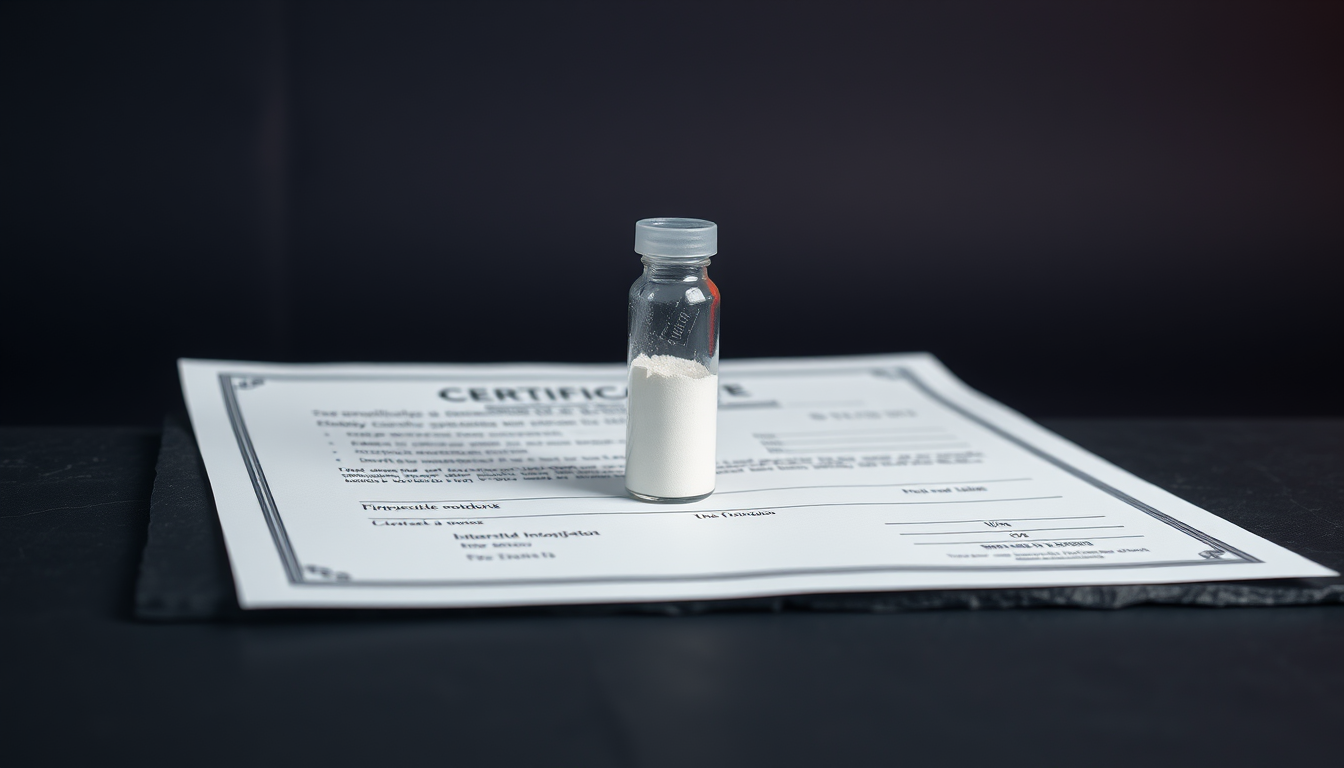
This article explains why a research peptide vial labeled 5 mg or 10 mg can look almost empty, how little space a few milligrams of lyophilized solid actually occupies, why the appearance of the cake varies from lot to lot and vial to vial, how fill weight is verified during manufacture, and why the measured content on the certificate of analysis, not the look of the vial, is the quantity that counts.
The short answer: milligrams of solid are a few microliters of volume
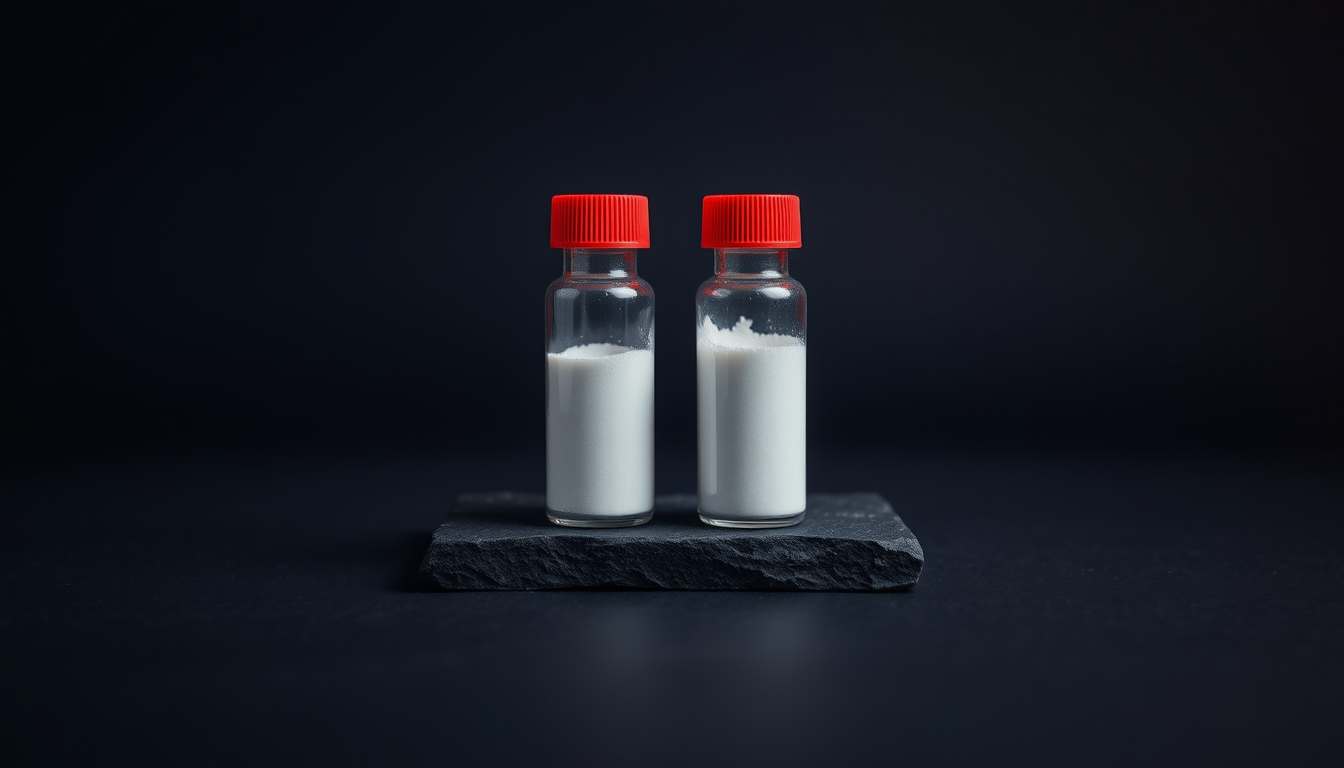
A vial that appears to hold almost nothing is usually holding exactly what the label states, because 5 or 10 mg of a dry peptide occupies only a few microliters, and a few microliters spread as a thin film or a small cake in a 2 or 3 mL vial is close to invisible. Dry peptides and proteins have a true solid density near 1.3 to 1.4 g/cm³, so 10 mg of fully compacted material would be a droplet-sized speck of roughly 7 µL. Lyophilization does not compact the material; it leaves a porous cake whose outer dimensions match the frozen fill volume, but whose actual solid content is still that same few microliters, distributed through a sponge of empty space.
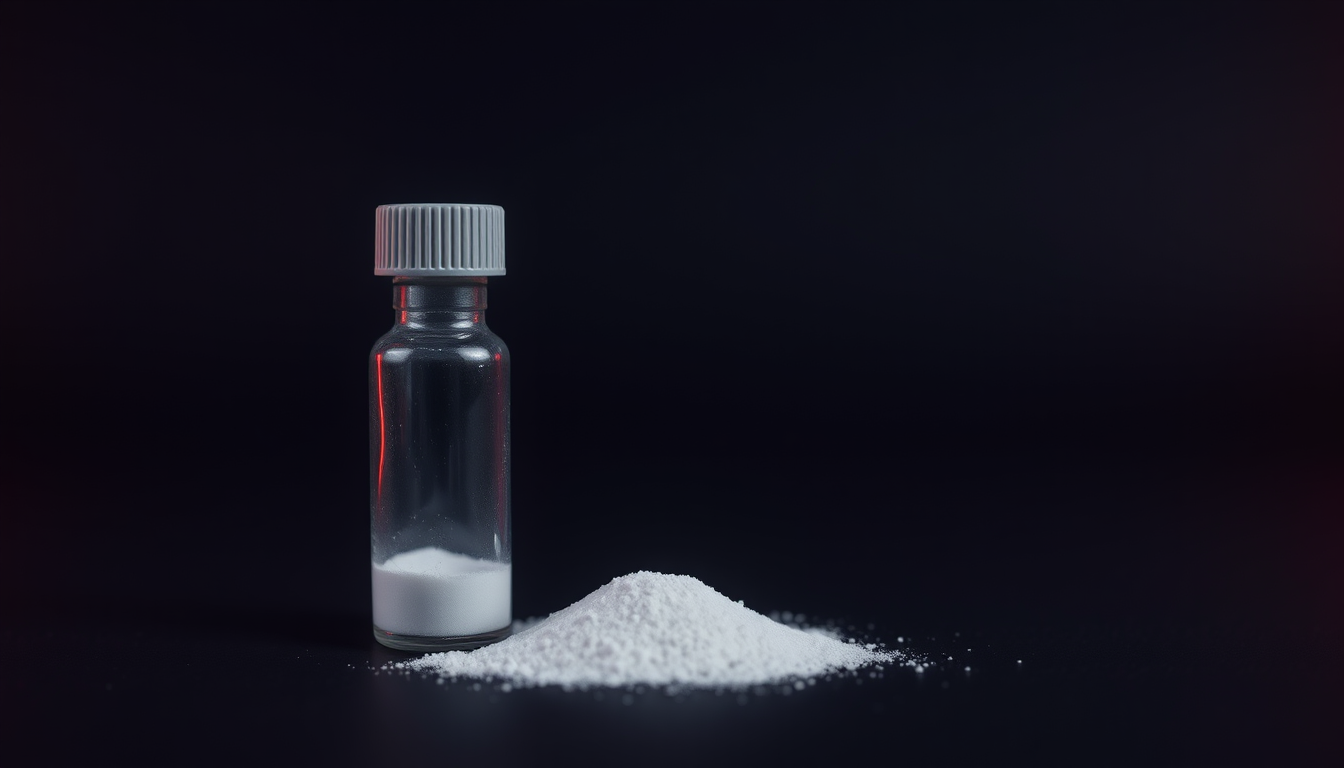
Two consequences follow. First, the cake's size tells you about the volume of solution that was frozen, not about the mass of peptide it contains. Second, when a fragile cake breaks during shipping and settles as a dusting of powder on the base or shoulder of the vial, the eye reads "empty" even though nothing has left the container. The honest way to answer "how much is in there" is the certificate's net peptide content line, which the article on net peptide content versus purity explains in detail.
| Label mass | Approximate volume as compact solid (density ~1.35 g/cm³) | What it can look like in a 2 mL vial |
|---|---|---|
| 1 mg | ~0.7 µL | Faint film or a few specks; often invisible without tilting against light |
| 2 mg | ~1.5 µL | Thin translucent film on the base |
| 5 mg | ~3.7 µL | Small white film or fragments of a low cake |
| 10 mg | ~7.4 µL | Visible white cake or powder a millimeter or two deep, depending on fill volume |
| 50 mg | ~37 µL | Obvious cake or loose powder layer |
Volumes assume a fully dense solid; the cake's outer volume is set by the fill volume and is far larger.
Why cake volume depends on fill volume, not peptide mass
During freeze-drying the solution is frozen first, so the ice occupies the full fill volume, and when the ice sublimes it leaves behind a scaffold of solids that traces the shape of the ice it replaced. Kasper and Friess describe the freezing step in their 2011 review in the European Journal of Pharmaceutics and Biopharmaceutics: the solution supercools, nucleates, and the growing ice crystals push the dissolved solids into channels between them; the size and arrangement of those channels, fixed during freezing, determine the pore structure, the drying rate and the appearance of the finished cake. A 0.5 mL fill produces a cake about 0.5 mL in outer volume whether it carried 2 mg or 20 mg of peptide, and a 0.1 mL fill of the same solution gives a cake one fifth the height.
At very low solids content there is not enough material to hold a self-supporting scaffold, and the product dries as a film, a ring, or a crumbly layer rather than a neat plug. Formulators who need a visible, robust cake add a bulking agent such as mannitol or glycine, which crystallizes during freezing and forms a rigid matrix. Horn, Tolardo, Fissore and Friess explored this in a 2018 study of crystallizing amino acids as alternative bulking agents, showing that phenylalanine, leucine and isoleucine crystallized at low ratios to sucrose and supported a cake even through an aggressive drying cycle, while mannitol and glycine gave unacceptable cake appearance under the same fast process. A research peptide vial that contains only the peptide and its counter-ion, with no bulking agent, will never produce the elegant plug of a formulated product, which keeps the certificate simple.
Why cakes look different from lot to lot and vial to vial
Variation in cake appearance is expected, and the freeze-drying literature describes it as a function of process and formulation rather than of peptide quantity. Patel, Nail, Pikal and colleagues, writing in the Journal of Pharmaceutical Sciences in 2017, provide a harmonized nomenclature for departures from a uniform, elegant cake, including shrinkage, cracking, collapse, meltback, fogging and dusting, and argue that a non-ideal appearance "sometimes" has no impact on product quality and is simply an inherent characteristic of the formulation and process.
Even within one batch, position on the shelf changes the cake. Rambhatla and Pikal showed in AAPS PharmSciTech (2003) that vials at the edge of a freeze-dryer shelf receive extra heat by radiation from the walls and door, so they dry faster and at higher product temperature than vials in the center; that edge-vial effect alone can produce visible differences in cake texture across a single lot. Tang and Pikal's 2004 process-design review adds that the product temperature during primary drying must stay below the collapse temperature of the amorphous phase, and that cycles are run with a margin because a brief excursion above it produces a shrunken or collapsed cake. Shipping then rearranges whatever the dryer produced.
| Appearance | Likely origin | Does it change peptide mass? |
|---|---|---|
| Thin film or ring on the base | Low fill volume or low solids, no bulking agent | No |
| Intact white plug | Higher solids or bulking agent, gentle cycle | No |
| Loose powder, cake broken | Mechanical shock in transit | No |
| Powder on the shoulder or stopper | Inverted or shaken in transit | No; material is still inside the sealed vial |
| Shrunken, cracked or pulled from the wall | Drying near the collapse temperature; edge-vial heating | No; may slow dissolution |
| Glassy, dense, wet-looking or sticky | Collapse or moisture ingress through the closure | Mass unchanged, but stability may be compromised; report it |
How fill weight is verified during manufacture
Fill weight is controlled by weighing, not by eye, and it is checked at two points: the concentration of the bulk solution before filling, and the mass of solution delivered into each vial. Because a lyophilized peptide vial is filled as a liquid, the mass of peptide in the vial equals the solution concentration multiplied by the fill mass, and both are measured. The bulk solution is assayed, typically by UV absorbance or HPLC against a reference standard, so that its peptide concentration is known; then vials are tared and filled on a balance, or filled by a calibrated volumetric pump with gravimetric spot checks at intervals through the run. Analytical balances read to 0.1 mg or 0.01 mg, far finer than the peptide mass itself.
The result is that the mass in a vial is traceable to two measurements made on instruments with calibration records, and that the visual size of the cake plays no part in the control. Wang's 2000 review of lyophilization notes the parameters that are specified and monitored in a well-designed cycle, among them fill volume, solids content, shelf temperature and chamber pressure; a vial that looks nearly empty because it was filled with 0.2 mL of a dilute solution and a vial that shows a tall plug because it was filled with 1 mL of a solution carrying mannitol can contain the same peptide mass. The process that creates the cake is described in how research peptides are made.
What "measured content" on the certificate means
The certificate of analysis is the document that answers the quantity question, and it does so with two separate numbers: purity by HPLC, which says what fraction of the peptide-related material is the intended sequence, and net peptide content, which says what fraction of the gross mass in the vial is peptide rather than water and counter-ion. Neither is a visual estimate. Purity is an area percent from a chromatogram; content is determined by a quantitative method such as amino acid analysis, UV absorbance against the sequence's calculated extinction coefficient, or elemental nitrogen analysis, and it is reported because a lyophilized peptide salt always carries bound water and counter-ion that add to the weighed mass.
US Prime Peptides posts the lot-matched certificate on each product page, including identity by mass spectrometry, purity by HPLC and net peptide content, so the buyer can read the measured quantity before the vial is ever inspected. When a lab wants to confirm the figure independently, the approach is analytical rather than visual: the vial's entire contents are taken into a known volume and quantified by UV or HPLC against a reference standard, and the result is compared with the label mass corrected for the certificate's content value. That check belongs in the notebook alongside the lot number. The article on reading a certificate of analysis line by line walks through each field.
When an empty-looking vial is actually a problem
An empty-looking vial is a concern only when something other than the cake's size is wrong: a crimp that is loose, a stopper that is not seated, a cake that is glassy, wet or discolored, visible glass flakes, or a lot number that does not match a posted certificate. Each of those points to a container or documentation failure, not to a shortfall of peptide, and each should be photographed and reported before the vial is opened. A film instead of a plug, powder instead of a cake, or material on the shoulder after transit are not in that category.
A lab that records the lot number, the certificate's purity and content, the vial's visual condition at receipt and the date it entered storage has everything it needs to trace any later discrepancy to adsorption, degradation or an assay issue rather than to the original fill. The packaging components that keep that mass dry and sealed are covered in the vial, the stopper and the seal.
Frequently Asked Questions
Why does my 5 mg peptide vial look empty?
Because 5 mg of dry peptide is only about 4 µL of solid, and after freeze-drying it sits as a thin film or small cake in a vial that holds 2 or 3 mL. The mass is verified by weighing during fill and by the certificate's net peptide content, not by the look of the vial.
Does a bigger cake mean more peptide?
No. Cake volume follows the volume of solution that was frozen and whether a bulking agent such as mannitol was included; Kasper and Friess describe how ice crystal structure fixes the cake's shape. Two vials with identical peptide mass can show a tall plug and a thin film if they were filled with different volumes.
Is powder on the stopper or shoulder of the vial a sign of a bad lot?
No. A lyophilized cake is fragile and mechanical shock during shipping often breaks it into powder that settles wherever the vial was last oriented. The material is still inside the sealed container. Patel and colleagues' 2017 commentary classifies such appearance variations and notes that they often have no bearing on product quality.
How is the amount of peptide in a vial actually verified?
By assaying the bulk solution's concentration before filling and weighing each fill on a calibrated balance, then by the certificate's net peptide content, which is measured by amino acid analysis, UV absorbance or nitrogen analysis. A laboratory can confirm it independently by quantitative UV or HPLC of the entire vial contents against a reference standard.
Citations
- Patel SM, Nail SL, Pikal MJ, et al. Lyophilized drug product cake appearance: what is acceptable? J Pharm Sci. 2017;106:1706-1721. PMID 28341598
- Kasper JC, Friess W. The freezing step in lyophilization: physico-chemical fundamentals, freezing methods and consequences on process performance and quality attributes of biopharmaceuticals. Eur J Pharm Biopharm. 2011;78:248-263. PMID 21426937
- Horn J, Tolardo E, Fissore D, Friess W. Crystallizing amino acids as bulking agents in freeze-drying. Eur J Pharm Biopharm. 2018;132:70-82. PMID 30201570
- Rambhatla S, Pikal MJ. Heat and mass transfer scale-up issues during freeze-drying, I: atypical radiation and the edge vial effect. AAPS PharmSciTech. 2003;4:E14. PMID 12916896
- Tang X, Pikal MJ. Design of freeze-drying processes for pharmaceuticals: practical advice. Pharm Res. 2004;21:191-200. PMID 15032301
- Wang W. Lyophilization and development of solid protein pharmaceuticals. Int J Pharm. 2000;203:1-60. PMID 10967427
- Carpenter JF, Pikal MJ, Chang BS, Randolph TW. Rational design of stable lyophilized protein formulations: some practical advice. Pharm Res. 1997;14:969-975. PMID 9279875
This article is for laboratory research reference only. US Prime Peptides products are supplied strictly for in vitro research. Not for human consumption.
Related research
- What a Peptide Certificate of Analysis Does Not Test For
- Why a Second Laboratory Matters: Independent Testing vs Manufacturer Certificates
- What 'Lyophilized' Means and Why Peptides Ship as a Powder
- Why Some Peptides Dissolve Badly: Hydrophobicity, Aggregation, and Net Charge
- Research Peptide Glossary: 60 Terms Every Lab Buyer Should Know
Compliance Notice: US Prime Peptides products are supplied strictly for laboratory and academic research purposes only. They are not intended for human or veterinary consumption, diagnosis, treatment, or prevention of any disease. All content on this page is educational in nature and does not constitute medical advice or product claims. Researchers are responsible for handling these compounds in accordance with their institution’s safety protocols and applicable laws.