Research-use-only context. This article summarizes published third-party scientific literature and laboratory practice. It is not medical advice, not a therapeutic or performance claim, and not a usage guide. US Prime Peptides products are supplied strictly for in vitro laboratory research and are not for human or veterinary use.
"Lyophilized" on a peptide label means the material was freeze-dried: dissolved, frozen, and stripped of its water by sublimation under vacuum until only a porous solid remained. This article explains the three stages of that process, what the cake in the vial is, what residual moisture and glass transition mean, and why the dry solid, not a solution, is the form in which research peptides are shipped and stored.
What lyophilized means
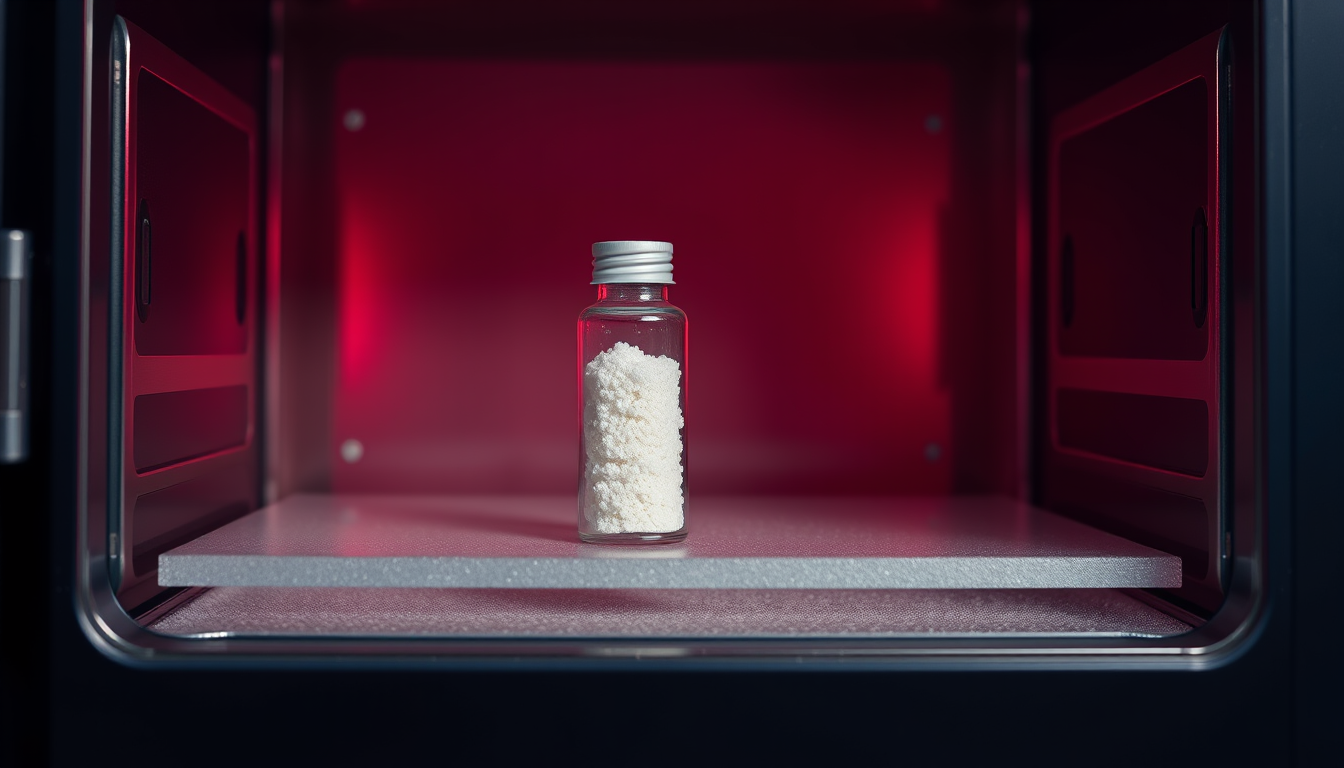
Lyophilization is the removal of water from a frozen solution by sublimation, so that ice passes directly to vapor without melting, followed by desorption of the small amount of water that remains bound to the solid. Nail and colleagues' 2002 chapter "Fundamentals of freeze-drying" in Pharmaceutical Biotechnology describes the process in three stages: freezing, primary drying, and secondary drying. The product temperature stays well below zero through the first two stages and only rises toward room temperature in the third, which is why heat-sensitive molecules survive the process when they would not survive evaporation in an oven.
The word itself comes from the Greek for "solvent-loving," a reference to how readily the dried solid redissolves. That property follows from the structure the process leaves behind: because ice is removed without the solid ever collapsing into a liquid, the result is a sponge-like cake with the same outline the frozen solution had, full of channels that water can re-enter quickly. Tang and Pikal's 2004 review in Pharmaceutical Research is the standard practical reference for how a cycle is designed, and most of what follows draws on it.
Stage one: freezing and the freeze-concentrate
Freezing turns most of the water in the vial into ice crystals and squeezes the peptide, buffer salts, and any excipient into a concentrated amorphous phase between those crystals. Kasper and Friess's 2011 review in the European Journal of Pharmaceutics and Biopharmaceutics walks through the physics: as ice grows, the solute concentration in the remaining liquid climbs sharply, pH can shift as buffer components crystallize at different rates, and the final freeze-concentrate becomes a glass at a characteristic temperature written Tg'. Below Tg' the matrix is rigid; above it the concentrate is viscous enough to flow and will slump during drying.
How the ice nucleates matters. Searles, Carpenter, and Randolph's 2001 study in the Journal of Pharmaceutical Sciences froze hydroxyethyl starch solutions in vials on a lyophilizer shelf and found that the temperature at which ice first nucleated, which is stochastic and varies from vial to vial, was the main determinant of the later drying rate. Vials that supercooled further formed smaller ice crystals, narrower channels, and dried more slowly. Producers control this with annealing steps or controlled nucleation so that every vial in a lot has a similar pore structure.
Stage two: primary drying and the collapse temperature
Primary drying removes the ice by sublimation: the chamber is evacuated, the shelf is warmed just enough to supply the latent heat of sublimation, and the water vapor is trapped on a condenser colder than the product. Tang and Pikal explain that the product temperature must be held below the collapse temperature, which is close to Tg' for amorphous systems, so the solid skeleton left behind keeps its shape. If the product warms past that point the cake collapses, pore channels close, residual moisture rises, and reconstitution slows.
Knowing when primary drying has finished is a measurement problem in its own right. Patel, Doen, and Pikal's 2010 paper in AAPS PharmSciTech compared seven end-point indicators using mannitol and sucrose model systems and found that the difference between a Pirani gauge (which reads high while water vapor is present) and a capacitance manometer gave the most reliable signal that sublimation had stopped. Raising the shelf temperature before all ice is gone risks melt-back in the slowest vials, which is why the step is held longer than the average vial needs.
Stage three: secondary drying and residual moisture
After the ice is gone, the cake still holds water adsorbed to the solid, often five to ten percent by mass, and secondary drying removes most of it by raising the shelf temperature while keeping the vacuum. The target is a low but deliberately non-zero water content, usually reported as a percentage by Karl Fischer titration.
Why not dry to zero? Hsu and colleagues' 1992 study in Developments in Biological Standardization dried methionyl human growth hormone and tissue plasminogen activator to a range of moisture contents and found that samples dried below the monolayer of water predicted from the proteins' polar groups showed opalescence on reconstitution, while samples left wetter lost activity faster under temperature stress. Their conclusion, that "the drier the better" is not a universal rule, has been borne out since. Chang and Pikal's 2009 review in the Journal of Pharmaceutical Sciences explains the mechanism: water acts as a plasticizer that increases molecular mobility in the glass, so more moisture means faster degradation, but the hydrogen-bonding network that excipients such as sucrose form with the dried molecule also needs a small amount of water to stay intact. A certificate that reports water content is reporting the outcome of this balance.
Why the solid is the stable shipping form
A peptide in the dry state degrades far more slowly than the same peptide in water because the main degradation reactions need water as a reactant, a solvent, or a source of molecular mobility. Lai and Topp's 1999 review of solid-state chemical stability in the Journal of Pharmaceutical Sciences lists the routes that persist in solids, deamidation, oxidation, hydrolysis, and covalent dimerization among them, and shows that their rates depend strongly on residual moisture and on whether the matrix is above or below its glass transition. Manning and colleagues' 2010 update in Pharmaceutical Research covers the same reactions in solution, where they run orders of magnitude faster. Wang's 2000 review in the International Journal of Pharmaceutics is the long-form account of why solid forms were adopted for proteins in the first place.
| Degradation route | In solution | In the lyophilized solid |
|---|---|---|
| Hydrolysis of peptide bonds (notably at Asp) | Proceeds continuously; pH-dependent | Needs residual water; very slow at low moisture |
| Deamidation of Asn and Gln | Fast at neutral to basic pH | Slowed by low moisture and a rigid glass |
| Oxidation of Met, Cys, Trp | Driven by dissolved oxygen, light, trace metals | Reduced by nitrogen headspace and darkness |
| Aggregation | Concentration- and temperature-dependent | Limited by immobility below Tg |
| Microbial growth | Possible once the seal is broken | Not supported in a dry solid |
Shipping a solid also removes the weakest link in cold-chain logistics. A solution left warm in a delivery truck for two days is a different material from the one that left the lab; a lyophilized cake tolerates the same excursion with a far smaller change. This is why reconstitution is left to the receiving laboratory and recorded there, as described in peptide storage and stability.
What the cake tells you when the vial arrives
A well-made lyophilized cake is a uniform, porous plug or disk that keeps the shape of the frozen fill; a collapsed, shrunken, or glassy-looking residue indicates the product temperature went too high during drying. The size of the cake says almost nothing about the peptide mass. Cake volume is set by the total solids in the fill, and a research vial containing a few milligrams of peptide with no bulking agent will show only a thin film or a few flakes, which is the normal appearance explained in why the vial looks empty.
Other things to note on arrival are that the stopper is seated and the crimp intact, that the cake is dry and free-moving rather than stuck to the glass in a wet smear, and that the lot number on the label matches the certificate. US Prime Peptides lots are synthesized and lyophilized in the USA and ship with a lot-matched, independently issued certificate covering identity, purity, net content, endotoxin, sterility, and heavy metals. For how those lines are read, see how to read a peptide certificate of analysis; for the production steps that lead up to the freeze-dryer, see how research peptides are made.
Frequently Asked Questions
What does lyophilized mean?
Lyophilized means freeze-dried. The solution is frozen, the ice is removed by sublimation under vacuum, and the last bound water is driven off by gentle warming, leaving a porous solid cake. The word is used on labels to tell you the vial contains a dry solid, not a liquid.
Why do peptides ship as a powder instead of a liquid?
Because the reactions that degrade a peptide, hydrolysis, deamidation, oxidation, and aggregation, all run much faster in water than in a dry glassy solid. Lyophilization removes the water without heating the peptide, so the solid survives shipping and storage with far less change than a solution would.
What is the glass transition temperature in freeze-drying?
It is the temperature at which the amorphous, freeze-concentrated solid changes from a rigid glass to a mobile, rubbery state. During drying the product must stay below it, or the cake collapses; in storage, keeping the dried solid well below its glass transition keeps molecular motion, and therefore degradation, slow.
Why is there so little powder in a lyophilized peptide vial?
Because a research vial usually contains only a few milligrams of peptide and no bulking excipient, so the cake is a thin film or a few flakes rather than a full plug. The amount present is verified by the fill mass and net peptide content on the certificate, not by eye.
Citations
- Nail SL, Jiang S, Chongprasert S, Knopp SA. Fundamentals of freeze-drying. Pharm Biotechnol. 2002;14:281-360. PMID 12189727
- Tang X, Pikal MJ. Design of freeze-drying processes for pharmaceuticals: practical advice. Pharm Res. 2004;21:191-200. PMID 15032301
- Kasper JC, Friess W. The freezing step in lyophilization: physico-chemical fundamentals, freezing methods and consequences on process performance and quality attributes of biopharmaceuticals. Eur J Pharm Biopharm. 2011;78:248-263. PMID 21426937
- Searles JA, Carpenter JF, Randolph TW. The ice nucleation temperature determines the primary drying rate of lyophilization for samples frozen on a temperature-controlled shelf. J Pharm Sci. 2001;90:860-871. PMID 11458335
- Patel SM, Doen T, Pikal MJ. Determination of end point of primary drying in freeze-drying process control. AAPS PharmSciTech. 2010;11:73-84. PMID 20058107
- Hsu CC, Ward CA, Pearlman R, Nguyen HM, Yeung DA, Curley JG. Determining the optimum residual moisture in lyophilized protein pharmaceuticals. Dev Biol Stand. 1992;74:255-270. PMID 1592175
- Chang LL, Pikal MJ. Mechanisms of protein stabilization in the solid state. J Pharm Sci. 2009;98:2886-2908. PMID 19569054
- Lai MC, Topp EM. Solid-state chemical stability of proteins and peptides. J Pharm Sci. 1999;88:489-500. PMID 10229638
- Manning MC, Chou DK, Murphy BM, Payne RW, Katayama DS. Stability of protein pharmaceuticals: an update. Pharm Res. 2010;27:544-575. PMID 20143256
- Wang W. Lyophilization and development of solid protein pharmaceuticals. Int J Pharm. 2000;203:1-60. PMID 10967427
This article is for laboratory research reference only. US Prime Peptides products are supplied strictly for in vitro research. Not for human consumption.
Related research
- Why Some Peptides Dissolve Badly: Hydrophobicity, Aggregation, and Net Charge
- Reconstitution as Chemistry: Concentration, Solubility, and pH
- Peptide Storage and Stability: Temperature, Light, Moisture, and Time
- How Long Does a Reconstituted Peptide Last? Where the 28-Day Number Comes From
- Bacteriostatic Water vs Sterile Water vs Reconstitution Solution: What Each Is For
Compliance Notice: US Prime Peptides products are supplied strictly for laboratory and academic research purposes only. They are not intended for human or veterinary consumption, diagnosis, treatment, or prevention of any disease. All content on this page is educational in nature and does not constitute medical advice or product claims. Researchers are responsible for handling these compounds in accordance with their institution’s safety protocols and applicable laws.