Research-use-only context. This article summarizes published third-party scientific literature and laboratory practice. It is not medical advice, not a therapeutic or performance claim, and not a usage guide. US Prime Peptides products are supplied strictly for in vitro laboratory research and are not for human or veterinary use.
A research peptide begins as a sequence on paper and ends as a few milligrams of white solid under a crimped stopper. This article follows that route step by step: solid-phase synthesis on a resin, acid cleavage, purification by preparative reversed-phase HPLC, counter-ion exchange, lyophilization, and fill. It also explains why each step leaves a characteristic trace that a certificate of analysis is designed to detect.
The route in one paragraph
Almost every synthetic peptide sold for research is built one amino acid at a time on a solid polymer support, cut off that support with acid, purified by chromatography, converted to a defined salt form, freeze-dried, and weighed into vials. Kent's 1988 review in Annual Review of Biochemistry describes how the solid-phase approach, introduced by Merrifield in 1963, displaced solution-phase synthesis because the growing chain can be washed free of excess reagents between steps without isolating any intermediate. Behrendt, White, and Offer's 2016 review in the Journal of Peptide Science records that the Fmoc/tBu version of the method is now the default, with building blocks produced at multi-ton scale. The process is the same whether the target is a five-residue pentapeptide or a 39-residue analog; what changes is the number of cycles, the difficulty of certain stretches, and how much purification is needed at the end.
The steps below are presented in production order. The last section maps each one to the line on the certificate that checks it, which is the part a lab buyer actually sees.
Step 1: Solid-phase synthesis on a resin
Solid-phase peptide synthesis (SPPS) anchors the C-terminal amino acid to an insoluble resin bead and then adds the remaining residues one at a time, from the C-terminus toward the N-terminus, in a repeating cycle of deprotection, washing, coupling, and washing. Each incoming amino acid carries a temporary group on its alpha-amine (Fmoc, removed with piperidine) and, where needed, a more durable group on its side chain (tert-butyl, trityl, Boc, Pbf, and others) that stays on until the end. Isidro-Llobet, Alvarez, and Albericio's 2009 Chemical Reviews survey catalogs these protecting groups and the orthogonal logic that lets one be removed without disturbing the other.
Coupling is where the peptide bond actually forms. The carboxyl group of the incoming amino acid is activated by a reagent such as HBTU, HATU, or DIC with an additive, so that it reacts with the free amine on the resin-bound chain within minutes. El-Faham and Albericio's 2011 review explains why reagent choice matters: faster activation means fewer incomplete couplings, but some reagents raise the risk of racemizing the activated residue. Coin, Beyermann, and Bienert's 2007 Nature Protocols paper gives a standard Fmoc cycle and then shows what happens with "difficult sequences," where the growing chain aggregates on the resin and couplings stall; pseudoproline dipeptides and depsipeptide units are the usual fixes. Amblard and colleagues' 2006 methods paper covers the same ground for a non-specialist audience.
Every incomplete coupling leaves a chain that is missing one residue. Those deletion sequences travel through every later step alongside the full-length product, which is why purity is a question from the first cycle, not just the last.
Step 2: Cleavage and where trifluoroacetate comes from
When the last residue is on, the peptide is released from the resin and stripped of its side-chain protecting groups in one acid step, almost always with concentrated trifluoroacetic acid (TFA) plus scavengers such as water, triisopropylsilane, or thioanisole. The scavengers trap the reactive carbocations shed by the departing protecting groups so they do not re-attach to tryptophan, methionine, or cysteine. The crude peptide is then precipitated into cold ether, collected, and dried.
Because the chain's basic groups (the N-terminal amine, lysine, arginine, histidine) are protonated in TFA, the solid that comes out of the ether is a trifluoroacetate salt. Roux and colleagues' 2008 paper in the Journal of Peptide Science notes that most synthetic peptides are obtained this way and that the counter-ion follows the product into purification, since TFA is also the standard mobile-phase modifier in reversed-phase HPLC. The consequences of that counter-ion are discussed in TFA salt vs acetate salt.
The cleavage step also produces its own impurity family: incompletely deprotected chains (a tert-butyl group that stayed on, adding 56 daltons), alkylated tryptophan, and oxidized methionine. These appear as small late- or early-eluting peaks around the main product.
Step 3: Purification by preparative reversed-phase HPLC
Crude synthetic peptide is purified by reversed-phase high-performance liquid chromatography on a C18 or C8 column at preparative scale, using a water-acetonitrile gradient with 0.1% TFA, then checked on an analytical column. Mant, Chen, and Hodges' 2007 chapter in Methods in Molecular Biology lays out the practice: the crude is dissolved, loaded, and eluted with a slow gradient so that the full-length peptide separates from deletion sequences, which usually elute slightly earlier or later because one missing residue changes hydrophobicity. Fractions are collected across the main peak, each is analyzed, and only those meeting the purity target are pooled.
Two points matter for reading a certificate. First, the purity figure on a COA comes from the same kind of separation, so the method that purified the peptide is also the method that grades it. Second, the choice of which fractions to pool is a trade-off between yield and purity: cutting the peak narrowly gives a cleaner product at lower yield. A lot specified at 99% or higher has typically been cut tighter than one specified at 95%. How that number is calculated, and what it leaves out, is covered in HPLC purity: what area percent does and does not tell you.
Step 4: Salt exchange and the switch to acetate
After purification the pooled fractions still contain trifluoroacetate, so most producers convert the peptide to the acetate (or sometimes hydrochloride) form before drying. Roux and colleagues compared the common approaches, including repeated lyophilization from dilute hydrochloric acid, anion-exchange resins, and HPLC with an acetate-containing mobile phase, and found that each removes trifluoroacetate to a different extent and that residual levels should be verified by ion chromatography or fluorine NMR rather than assumed. Cornish and colleagues reported in 1999 that trifluoroacetate at low micromolar concentrations changed the proliferation of cultured osteoblasts and chondrocytes, which is why cell-culture laboratories care which form they receive.
The exchange step is also where the mass balance of the vial is set. A peptide with several basic sites pairs with several counter-ions, and acetate (59 daltons) weighs roughly half as much as trifluoroacetate (113 daltons). The ratio of peptide mass to total solid mass is the net peptide content, a separate line on the certificate from purity.
Step 5: Lyophilization, fill, and finish
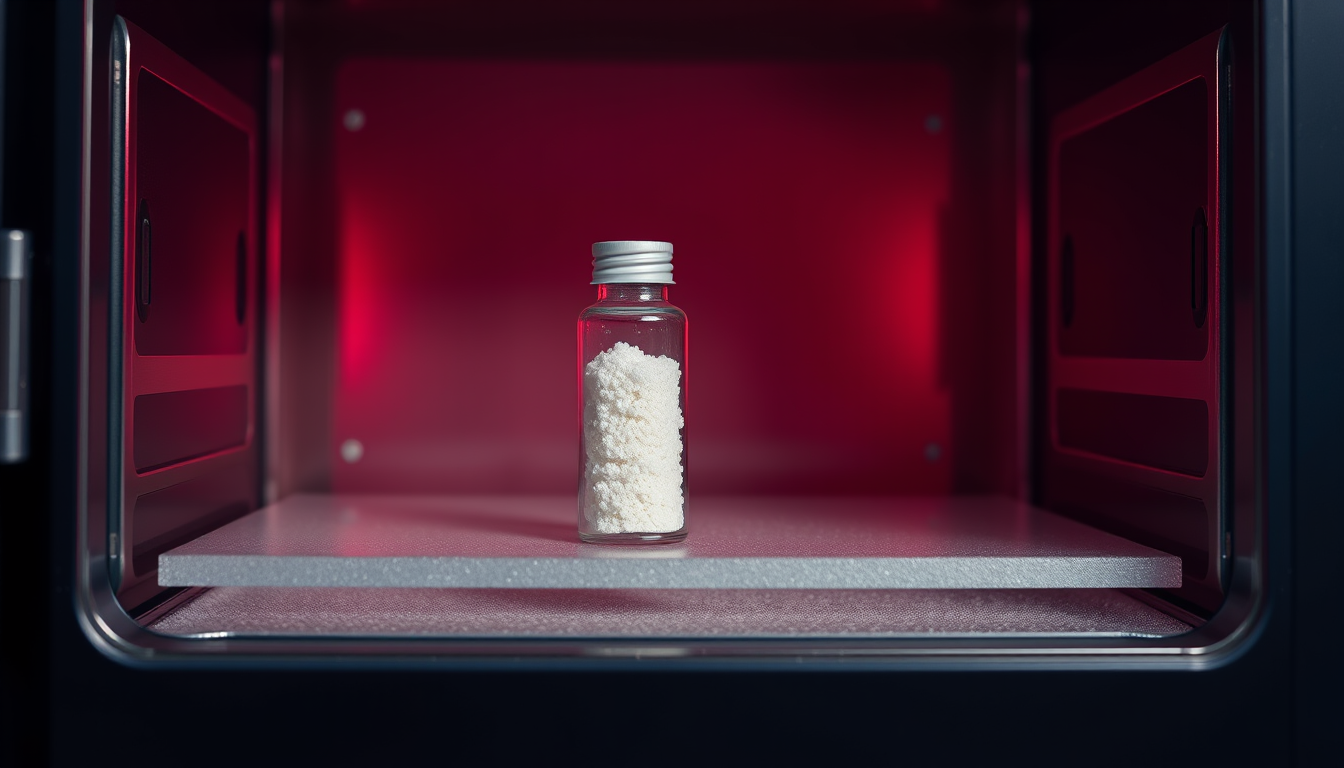
The purified peptide solution is frozen and dried by sublimation under vacuum, either in bulk and then weighed into vials, or dispensed as solution into vials and freeze-dried in place. Tang and Pikal's 2004 Pharmaceutical Research review sets out the three stages, freezing, primary drying below the collapse temperature, and secondary drying to remove bound water, and explains why the shelf temperature and chamber pressure are chosen to keep the frozen matrix rigid while ice sublimes. The result is a porous cake with low residual moisture, the form in which almost all research peptides ship. The physics is explained in what lyophilized means.
Fill is a weighing or volumetric step. For bulk-lyophilized material, the solid is weighed into each vial; for in-vial lyophilization, a solution of known concentration is dispensed by volume, so the mass per vial depends on the accuracy of both the concentration measurement and the dispenser. Vials are stoppered, often under nitrogen, and crimped. A lot number is assigned at this point, and that number is what links every vial to the testing that follows.
How each step shows up on the certificate
Each production step leaves a characteristic signature, and the certificate of analysis is a set of tests chosen to catch those signatures. The table maps them.
| Production step | What can go wrong | Certificate line that checks it |
|---|---|---|
| Solid-phase assembly | Deletion and truncated sequences; racemized residues | HPLC purity (area percent); LC-MS identity; chiral amino acid analysis where performed |
| Cleavage | Residual protecting groups; alkylation; oxidation | LC-MS (mass shifts of +56, +16); HPLC impurity peaks |
| Preparative HPLC | Co-eluting impurities; solvent residues | HPLC purity; residual solvents by GC headspace |
| Salt exchange | Residual trifluoroacetate; wrong counter-ion | Counter-ion content; net peptide content by amino acid analysis |
| Lyophilization | Collapsed cake; high residual moisture | Appearance; water content by Karl Fischer |
| Fill and finish | Under- or over-fill; microbial or endotoxin contamination | Fill mass or content per vial; endotoxin (LAL); sterility (USP 71) |
| Reagents and equipment | Trace metals | Heavy metals by ICP-MS |
US Prime Peptides lots are synthesized and lyophilized in the USA, tested by an independent US laboratory for identity, purity, net content, endotoxin, sterility, and heavy metals, and the lot-matched certificate is posted on the product page before purchase. Reading each line against the step that generated it is the subject of how to read a peptide certificate of analysis.
Frequently Asked Questions
How are research peptides made?
They are assembled one amino acid at a time on a resin bead by solid-phase peptide synthesis, released from the resin with trifluoroacetic acid, purified by preparative reversed-phase HPLC, converted to an acetate salt, freeze-dried, and weighed into vials. Each lot is then tested and issued a certificate of analysis.
What is solid-phase peptide synthesis?
It is Merrifield's method of building a peptide while it stays attached to an insoluble polymer support. Protected amino acids are coupled in sequence, and excess reagents are washed away between steps, so the chain never has to be isolated until the end.
Why do synthetic peptides contain TFA?
Trifluoroacetic acid is used both to cleave the finished peptide from the resin and as the modifier in HPLC purification, so the peptide's basic groups end up paired with trifluoroacetate ions. Producers usually exchange that counter-ion for acetate before lyophilization and should state which form was shipped.
Why is a peptide lyophilized instead of sold as a solution?
Freeze-drying removes the water in which hydrolysis, deamidation, and oxidation proceed, leaving a porous solid that is far more stable in storage and shipping. The dried cake also has a defined mass per vial that can be verified on the certificate.
Citations
- Kent SB. Chemical synthesis of peptides and proteins. Annu Rev Biochem. 1988;57:957-989. PMID 3052294
- Behrendt R, White P, Offer J. Advances in Fmoc solid-phase peptide synthesis. J Pept Sci. 2016;22:4-27. PMID 26785684
- Isidro-Llobet A, Alvarez M, Albericio F. Amino acid-protecting groups. Chem Rev. 2009;109:2455-2504. PMID 19364121
- El-Faham A, Albericio F. Peptide coupling reagents, more than a letter soup. Chem Rev. 2011;111:6557-6602. PMID 21866984
- Coin I, Beyermann M, Bienert M. Solid-phase peptide synthesis: from standard procedures to the synthesis of difficult sequences. Nat Protoc. 2007;2:3247-3256. PMID 18079725
- Amblard M, Fehrentz JA, Martinez J, Subra G. Methods and protocols of modern solid phase peptide synthesis. Mol Biotechnol. 2006;33:239-254. PMID 16946453
- Roux S, Zekri E, Rousseau B, Paternostre M, Cintrat JC, Fay N. Elimination and exchange of trifluoroacetate counter-ion from cationic peptides: a critical evaluation of different approaches. J Pept Sci. 2008;14:354-359. PMID 18035848
- Cornish J, Callon KE, Lin CQ, et al. Trifluoroacetate, a contaminant in purified proteins, inhibits proliferation of osteoblasts and chondrocytes. Am J Physiol. 1999;277:E779-E783. PMID 10567002
- Mant CT, Chen Y, Yan Z, et al. HPLC analysis and purification of peptides. Methods Mol Biol. 2007;386:3-55. PMID 18604941
- Tang X, Pikal MJ. Design of freeze-drying processes for pharmaceuticals: practical advice. Pharm Res. 2004;21:191-200. PMID 15032301
This article is for laboratory research reference only. US Prime Peptides products are supplied strictly for in vitro research. Not for human consumption.
Related research
Compliance Notice: US Prime Peptides products are supplied strictly for laboratory and academic research purposes only. They are not intended for human or veterinary consumption, diagnosis, treatment, or prevention of any disease. All content on this page is educational in nature and does not constitute medical advice or product claims. Researchers are responsible for handling these compounds in accordance with their institution’s safety protocols and applicable laws.