Research-use-only context. This article summarizes published third-party scientific literature and laboratory practice. It is not medical advice, not a therapeutic or performance claim, and not a usage guide. US Prime Peptides products are supplied strictly for in vitro laboratory research and are not for human or veterinary use.
This article explains the three-part package around a lyophilized research peptide: the glass vial, the elastomer stopper and the aluminum crimp seal, plus the gas in the headspace between them. It covers which USP general chapters govern each component, what the published studies say about glass delamination, stopper moisture, seal force and headspace oxygen, and what a laboratory can inspect when a vial arrives.
Three components, one job: keep the powder dry, dark and sealed
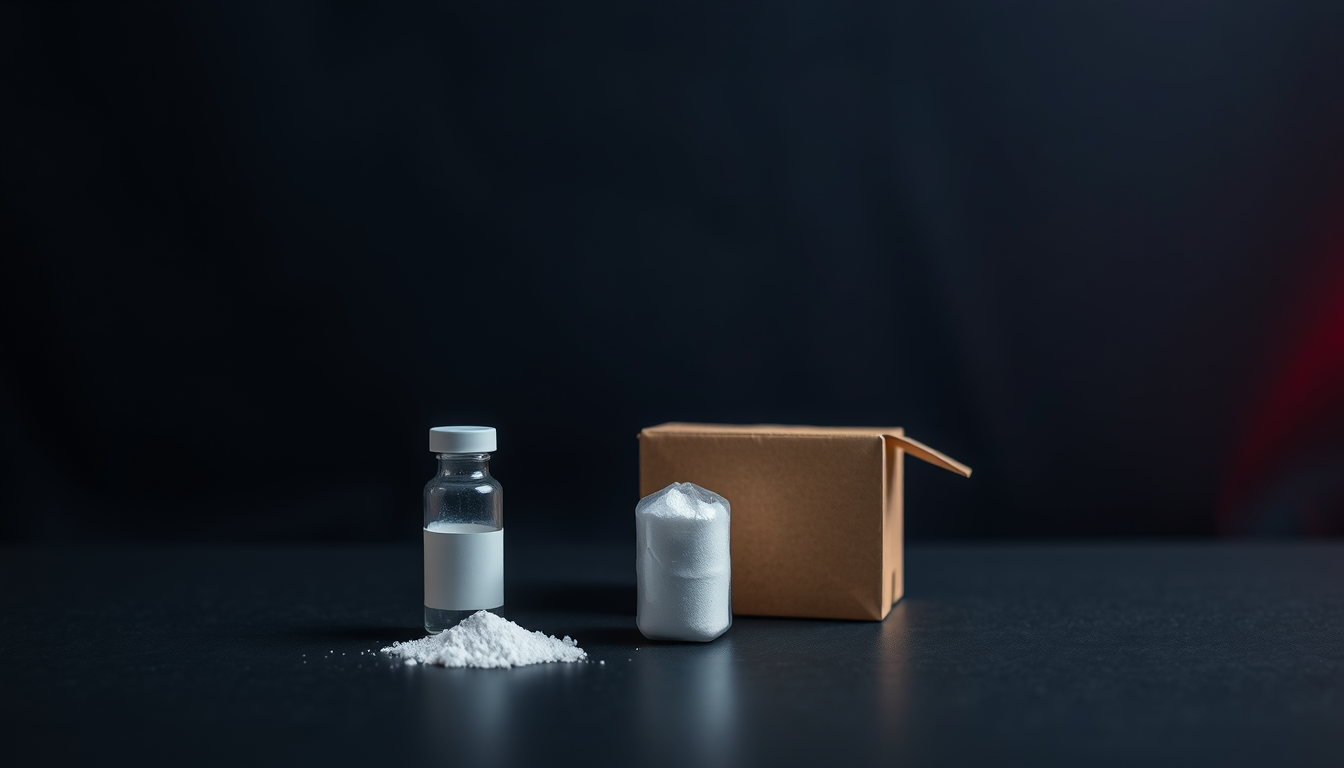
A peptide vial is a container-closure system in which the glass holds the product, the stopper closes the opening and the crimp seal holds the stopper under compression, and the system works only when all three meet their standards together. USP General Chapter <381> opens by defining packaging systems, also called container-closure systems, by reference to Chapter <659> as the sum of components that together contain and protect the product. Glass that is chemically durable is undone by a stopper that leaks water vapor, and an excellent stopper is undone by a crimp that does not compress it.
For a lyophilized peptide the job is specific. The cake must stay dry, because residual moisture governs solid-state degradation, as the article on cold-chain shipping explains; it must stay away from oxygen if the sequence contains methionine or cysteine; and it must stay sterile and free of glass particles until the vial is opened. Each requirement maps onto a component and a standard, summarized below.
| Component | Typical material | Governing standard | Function for a lyophilized peptide |
|---|---|---|---|
| Vial | Type I borosilicate glass, tubular, clear or amber | USP <660> Containers—Glass; USP <1660> inner-surface durability | Inert, hydrolytically resistant wall; amber blocks light |
| Stopper | Bromobutyl or chlorobutyl elastomer, lyophilization (slotted) or serum design, often fluoropolymer-coated | USP <381> elastomeric components | Gas and moisture barrier; pierceable; holds vacuum or nitrogen |
| Seal | Aluminum crimp with plastic flip-off disc | USP <1207> package integrity; residual seal force studies | Keeps the stopper compressed against the vial finish |
| Headspace | Nitrogen or partial vacuum | Headspace oxygen and CCI methods (USP <1207.2>) | Limits oxygen available for oxidation |
The glass: Type I borosilicate and why durability is tested
Peptide vials are made from Type I borosilicate glass, which USP <660> describes as having high hydrolytic resistance and high thermal shock resistance by virtue of its chemical composition, in contrast to Type II glass, soda-lime-silica with a dealkalized inner surface, and Type III, soda-lime-silica without surface modification and with only moderate hydrolytic resistance. Hydrolytic resistance describes how little of the glass dissolves into water that contacts it.
Even Type I glass is not inert forever. USP <1660> exists because the inner surface of a tubular vial can delaminate, shedding thin glass flakes into the product, and the chapter provides screening methods to detect glass particles and delamination and to compare glass across lots and manufacturers. Iacocca and colleagues, in a 2010 designed study in AAPS PharmSciTech, examined how thermal exposure during vial forming and depyrogenation, glass chemistry and contact with pharmaceutically relevant solutions combine to produce delamination. Watkins, Iacocca and colleagues followed in the Journal of Pharmaceutical Sciences (2014) with the finding that glass corrosion, the early stage before visible flakes, can already influence the chemical stability of a substance stored in the vial, that vials all classified as USP Type I differed by vendor and process, and that like-for-like interchangeability of glass containers should not be assumed. For a dry cake the exposure is far lower than for a stored solution, but Type I is a class, not a guarantee, and a supplier's choice of vial vendor is a quality decision.
| USP glass type | Composition | Hydrolytic resistance | Typical use |
|---|---|---|---|
| Type I | Borosilicate | High | Lyophilized and liquid parenteral-grade products, research vials |
| Type II | Soda-lime-silica, inner surface dealkalized | High (surface), moderate (bulk) | Some aqueous products |
| Type III | Soda-lime-silica, untouched | Moderate | Non-aqueous or dry products not sensitive to alkali |
The stopper: elastomer chemistry, moisture and gas
The stopper is the component that actually seals, and it is a chemically active material rather than an inert plug: a cross-linked butyl rubber compounded with fillers and vulcanizing agents, sometimes laminated with a fluoropolymer film on the product face. USP <381> sets out the biological reactivity and physicochemical tests for elastomeric components, covering what the rubber may leach into water and how it behaves on contact, while the functional tests for closures that are pierced, including fragmentation and self-sealing, have been moving into the companion Chapter <382>. Bromobutyl and chlorobutyl are the usual choices for lyophilized products because of their low gas and water-vapor permeability.
Low permeability is not zero. Pikal and Shah showed in a 1992 study using 13 mm slotted lyophilization stoppers that moisture does not pass through the stopper from outside, but that water already absorbed in the rubber migrates into the dried cake over time until the two reach equilibrium, raising product moisture well above its value at the end of drying. Stoppers that had been steam-sterilized and then vacuum-dried for eight hours transferred far less water than stoppers dried for one hour or not at all. The practical implication is that stopper processing, invisible to the buyer, is part of the cake's long-term moisture budget. Gas moves too: Gehrmann and McAndrew's one-year study of rubber-glass vial systems in the PDA Journal of Pharmaceutical Science and Technology (2020) observed a small oxygen exchange through the stoppers of every system tested, which they note is expected because rubber is gas-permeable.
Stopper design matters as well. Lyophilization stoppers have slots or an igloo shape that let water vapor escape during drying and are pushed fully home inside the dryer before the chamber is vented; serum stoppers are solid plugs inserted after a liquid fill. Ovadia, Lam, Tegoulia and Maa reported in the same journal that lyophilization stoppers maintained integrity even at zero residual seal force because of their excellent valve seal, whereas serum stoppers failed helium leak testing when residual seal force fell below about 15.8 N.
The seal: crimp force and container-closure integrity
The aluminum crimp exists to hold the stopper under compression, and the compression it maintains, called residual seal force, is the single measurable number that predicts whether the closure will hold. Ovadia and colleagues found a critical lower limit of roughly 19 to 20 N for both stopper types, and observed that some vials that initially failed integrity testing passed when retested months later, apparently because the rubber relaxed by viscous flow and filled minor imperfections in the vial finish. Gehrmann and McAndrew's design-of-experiments study across stopper formulations, vial sizes and vendors found no decrease in integrity over a year, but noted that lower compression gave slightly lower performance and wider scatter, and recommended against low residual seal force in commercial settings.
USP <1207> is the chapter that frames how integrity is demonstrated. It gives guidance on package integrity assurance for nonporous sterile product packages, covering leaks and leakage rates, closure sealing mechanisms and maximum allowable leakage limits, in three subchapters: <1207.1> on test method selection and validation across the product life cycle, <1207.2> on leak test technologies, and <1207.3> on seal quality tests. For a research vial, the buyer's view of all this is the crimp itself: a skirt rolled tightly under the vial finish with no gap, no rotation of the cap by hand, and a flip-off disc that is intact until the vial is opened.
The headspace: nitrogen, vacuum and oxygen
The gas above the cake is a formulation decision, and for peptides with oxidation-sensitive residues it is one of the most consequential. Pikal, Dellerman and Roy's 1992 stability study of freeze-dried human growth hormone found that methionine oxidation and aggregation depended strongly on headspace oxygen as well as residual moisture, with the best stability at low water and minimal oxygen. The same logic drives the practice of breaking the freeze-dryer vacuum with dry nitrogen and seating the stoppers before the chamber returns to atmosphere, so that the sealed vial contains either nitrogen at roughly atmospheric pressure or a partial vacuum, with little oxygen in either case.
Headspace oxygen has become a measurement in its own right. Hede, Fosbøl, Berg and Dahl described in the PDA Journal (2019) a container-closure integrity method for freeze-dried products that uses laser-based headspace oxygen analysis: a low-oxygen vial takes up oxygen through any leak at a rate governed by Fick's law, so measuring headspace oxygen non-destructively over time reveals leaks. A buyer cannot measure headspace, but there is a visible hint: a lyophilization stopper on a vacuum-sealed vial is drawn slightly inward, and a stopper that is domed outward on a vial that should be under vacuum suggests the headspace has equalized with the room. The oxidation chemistry that the headspace is protecting against is laid out in aliquots, freeze-thaw cycles and oxidation.
What a laboratory can inspect, and why the certificate does not cover it
A standard certificate of analysis tests the peptide, not the package, so the container is the one quality attribute the receiving lab verifies itself. The inspection is quick: hold the vial against light and look for cracks, chips at the finish and any glass flakes or shimmer in the cake area; check that the crimp skirt is rolled fully under the finish and the cap does not turn; confirm the stopper is seated flush and, for a vacuum-sealed product, slightly concave; note whether the cake is dry and white or glassy, shrunken and wet-looking, which can indicate a failed seal; and record the lot number against the posted certificate. The article on what a certificate of analysis does not test for lists container compatibility and storage history among the standard panel's blind spots, and this inspection is how a lab closes that gap.
US Prime Peptides supplies lyophilized peptides in sealed Type I glass vials with elastomer stoppers and aluminum crimps and posts the lot-matched certificate on each product page before purchase, so a receiving record can begin with both a verified analysis and a verified container. Packaging appears on a quality standard because the certificate describes the cake on the day it was tested, and the package keeps that description true until the vial is opened.
Frequently Asked Questions
What kind of glass are peptide vials made of?
Type I borosilicate glass, which USP <660> characterizes by high hydrolytic resistance and high thermal shock resistance. It releases far less alkali and silica into contact solutions than soda-lime Type II or Type III glass.
Why are peptide vials sealed under nitrogen or vacuum?
To limit the oxygen available for oxidizing methionine, cysteine, tryptophan and histidine residues. Pikal, Dellerman and Roy found that headspace oxygen and residual moisture together governed oxidation and aggregation of a freeze-dried protein. Breaking the dryer vacuum with nitrogen and stoppering before venting leaves little oxygen in the sealed vial.
Can moisture get through a rubber stopper?
Not through it, but out of it. Pikal and Shah found no moisture transmission through butyl lyophilization stoppers, but water absorbed in the rubber during steam sterilization migrated into the cake over time until equilibrium was reached; stoppers vacuum-dried for eight hours transferred much less.
How do I know if a vial's seal is intact?
Check that the aluminum crimp skirt is rolled tightly under the vial finish, the cap does not rotate by hand, the flip-off disc is in place, and the stopper is seated flush or slightly concave on a vacuum-sealed vial. A domed stopper, a loose cap, or a cake that looks glassy or wet suggests the headspace has equalized with the room and should be reported.
Citations
- United States Pharmacopeia. General Chapter <660> Containers—Glass. USP-NF. doi.usp.org
- United States Pharmacopeia. General Chapter <1660> Evaluation of the Inner Surface Durability of Glass Containers. USP-NF. doi.usp.org
- United States Pharmacopeia. General Chapter <381> Elastomeric Components in Pharmaceutical Product Packaging/Delivery Systems. USP-NF. doi.usp.org
- United States Pharmacopeia. General Chapter <1207> Package Integrity Evaluation—Sterile Products. USP-NF. doi.usp.org
- Iacocca RG, Toltl N, Allgeier M, et al. Factors affecting the chemical durability of glass used in the pharmaceutical industry. AAPS PharmSciTech. 2010;11:1340-1349. PMID 20740334
- Watkins MA, Iacocca RG, Shelbourn TL, Dong X, Stobba-Wiley C. Impact of glass corrosion on drug substance stability. J Pharm Sci. 2014;103:2456-2463. PMID 24989460
- Pikal MJ, Shah S. Moisture transfer from stopper to product and resulting stability implications. Dev Biol Stand. 1992;74:165-177. PMID 1592166
- Gehrmann MR, McAndrew TP. Long-term study of container closure integrity of rubber-glass vial systems by multiple methods. PDA J Pharm Sci Technol. 2020;74:147-161. PMID 31420507
- Ovadia R, Lam P, Tegoulia V, Maa Y. Quantifying the vial-capping process: reexamination using micro-computed tomography. PDA J Pharm Sci Technol. 2020;74:171-184. PMID 31420506
- Hede JO, Fosbøl PL, Berg SW, Dahl S. Container closure integrity testing: method development for freeze-dried products using laser-based headspace oxygen analysis. PDA J Pharm Sci Technol. 2019;73:170-180. PMID 30361284
- Pikal MJ, Dellerman K, Roy ML. Formulation and stability of freeze-dried proteins: effects of moisture and oxygen on the stability of freeze-dried formulations of human growth hormone. Dev Biol Stand. 1992;74:21-37. PMID 1592171
This article is for laboratory research reference only. US Prime Peptides products are supplied strictly for in vitro research. Not for human consumption.
Related research
- Why the Vial Looks Empty: Fill Weight, Cake Volume, and Label Accuracy
- Why Peptides Stick to Plastic, and How Labs Prevent Adsorption Loss
- Lab Supplies for Peptide Work: Water, Reconstitution Kits, and Low-Binding Consumables
- Do Lyophilized Peptides Need Cold-Chain Shipping?
- Aliquots, Freeze-Thaw Cycles, and Oxidation: Protecting a Peptide Solution
Compliance Notice: US Prime Peptides products are supplied strictly for laboratory and academic research purposes only. They are not intended for human or veterinary consumption, diagnosis, treatment, or prevention of any disease. All content on this page is educational in nature and does not constitute medical advice or product claims. Researchers are responsible for handling these compounds in accordance with their institution’s safety protocols and applicable laws.