Research-use-only context. This article summarizes published third-party scientific literature and laboratory practice. It is not medical advice, not a therapeutic or performance claim, and not a usage guide. US Prime Peptides products are supplied strictly for in vitro laboratory research and are not for human or veterinary use.
This article answers a question practice managers and lab buyers ask before every order: does a lyophilized research peptide need to travel cold? It covers why the freeze-dried solid tolerates ambient transit far better than any solution, how thermal stability is formally tested under ICH Q1A(R2), what a few days in a parcel means next to a six-month accelerated study, which formats genuinely need a cold pack, and what to check and record when a shipment arrives.
The short answer: the powder tolerates transit, the solution does not
A lyophilized peptide in a sealed vial is a dry, low-mobility solid, and the published stability literature regards days at ambient temperature as a minor stress for most such solids, while the same peptide dissolved in water degrades measurably within that time at elevated temperature. The 1999 review by Lai and Topp in the Journal of Pharmaceutical Sciences lists the degradation reactions that still occur in the solid state, including deamidation, peptide bond cleavage, oxidation, the Maillard reaction, beta-elimination and dimerization, and identifies temperature, moisture content, excipients and the amorphous or crystalline state of the formulation as the factors that control them. Keep moisture low and the vial sealed, and those reactions run slowly even when the box gets warm.
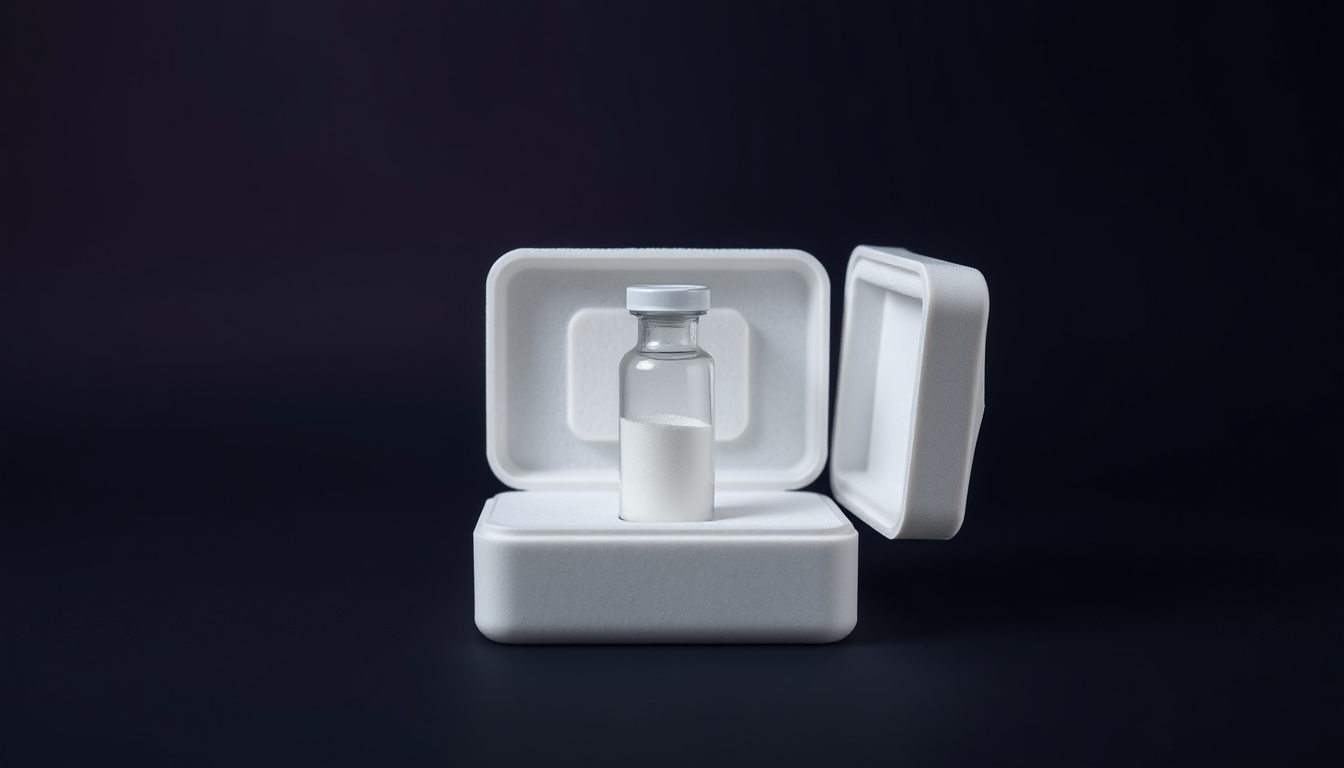
That is why most research-peptide suppliers, including US Prime Peptides, ship lyophilized vials in protective packaging at ambient temperature and reserve cold packs for aqueous formats. The question a buyer should ask is not whether the parcel was cold, but whether the vial arrived sealed, dry and intact, and whether the lot's certificate is posted so the starting purity is known. The companion article on what lyophilized means covers the freeze-drying process that creates this stability; this one covers what it means in transit.
What the solid state does for a peptide
Freeze-drying removes the water that makes degradation chemistry possible, leaving a glassy or crystalline cake in which molecules can barely move. Wang's 2000 review in the International Journal of Pharmaceutics describes the rationale: proteins and peptides are lyophilized precisely because the solid state slows the chemical and physical pathways that limit shelf life in solution, with residual moisture and the glass transition temperature of the cake as the two properties that decide how much mobility remains. Carpenter, Pikal, Chang and Randolph, in a 1997 Pharmaceutical Research paper, give the practical design rules: a stabilizing excipient that stays amorphous with the peptide, a drying cycle that brings residual water down to a low level, and storage well below the cake's glass transition.
Moisture is the variable that matters most during shipping, because it is the one a sealed vial can still gain if its closure is compromised. Costantino, Langer and Klibanov showed in Pharmaceutical Research (1994) that lyophilized insulin, a two-chain peptide with disulfide bridges, aggregated under elevated temperature and humidity through thiol-catalyzed disulfide interchange, and that the extent of aggregation tracked the water taken up by the powder. Pikal, Dellerman and Roy, studying freeze-dried human growth hormone, found that residual water content and headspace oxygen together governed methionine oxidation, deamidation and aggregation at 25 °C and 40 °C. A dry, nitrogen-backfilled, well-sealed vial is therefore protected on two fronts, and the stopper and crimp described in the vial, the stopper and the seal are doing most of the work.
How thermal stability is formally tested: ICH Q1A(R2)
The international standard for testing how a substance tolerates heat is ICH Q1A(R2), Stability Testing of New Drug Substances and Products, adopted by the FDA as guidance in 2003, and its conditions set the frame for any question about shipping temperature. The guideline specifies long-term testing at 25 °C ± 2 °C with 60% ± 5% relative humidity (or 30 °C/65% RH), an intermediate condition of 30 °C/65% RH, and an accelerated condition of 40 °C ± 2 °C with 75% ± 5% RH, with a minimum of six months of accelerated data and twelve months of long-term data. "Significant change" for a substance is defined as failure to meet its specification; for a product it includes a 5% change in assay from the initial value or any degradation product exceeding its limit.
Two sections of the guideline speak directly to transit. For substances intended for refrigerated storage, the accelerated condition is 25 °C/60% RH for six months, and if significant change occurs within the first three months the guideline asks for a discussion of "the effect of short term excursions outside the label storage condition, e.g., during shipping or handling." For substances intended for freezer storage at −20 °C ± 5 °C, the guideline asks for testing of a single batch at an elevated temperature such as 5 °C or 25 °C "to address the effect of short term excursions outside the proposed label storage condition, e.g., during shipping or handling." In other words, the framework assumes that shipping will take a product outside its label condition for a short time, and asks for data showing what that costs.
| ICH Q1A(R2) study | Storage condition | Minimum data at submission |
|---|---|---|
| Long term (general case) | 25 °C ± 2 °C / 60% RH ± 5% RH, or 30 °C ± 2 °C / 65% RH ± 5% RH | 12 months |
| Intermediate | 30 °C ± 2 °C / 65% RH ± 5% RH | 6 months |
| Accelerated | 40 °C ± 2 °C / 75% RH ± 5% RH | 6 months |
| Refrigerated substance, long term | 5 °C ± 3 °C | 12 months |
| Refrigerated substance, accelerated | 25 °C ± 2 °C / 60% RH ± 5% RH | 6 months |
| Frozen substance, long term | −20 °C ± 5 °C | 12 months, plus a single-batch excursion study at e.g. 5 °C or 25 °C |
Days in a parcel against months in a chamber
A domestic ground or air shipment spends two to five days in transit, and for a sealed lyophilized vial that interval is a small fraction of the six months at 40 °C/75% RH that an accelerated study imposes. The arithmetic is simple: a solid that holds its specification through roughly 4,400 hours at 40 °C is not meaningfully changed by 72 hours at a similar temperature, provided the closure keeps humidity out. This is why ambient shipping of lyophilized peptides is standard practice and why a cold pack for a freeze-dried cake is more reassurance than chemistry.
The real transit risks are different from the ones buyers usually worry about. The first is a heat spike rather than a warm average: a parcel left in a closed vehicle or on a sunlit loading dock in summer can exceed 40 °C for hours, and while a few hours at 50 °C is still a small fraction of an accelerated study, a cake near its glass transition can soften or collapse, which changes appearance and can raise mobility. The second is moisture entering through a damaged seal, which the Costantino and Pikal papers above show matters more than heat for many peptides. The third is physical shock, which breaks a fragile cake into loose powder; that is cosmetic, as the article on why the vial looks empty explains, but it should still be recorded. A gel pack addresses none of these; a sound closure, cushioning and prompt handling on receipt address all of them.
Which formats genuinely need a cold pack
Aqueous formats, meaning liquid sprays, reconstituted solutions and any product supplied already dissolved, are the ones for which transit temperature is a chemistry question rather than a comfort question. Hawe and colleagues measured oxytocin degradation in solution at 40, 55, 70 and 80 °C across a range of pH values in Pharmaceutical Research (2009) and found pseudo-first-order loss that followed Arrhenius kinetics, with deamidation, disulfide-linked dimers and oligosulfide species forming within the study windows.
Carriers organize their services around temperature bands that map onto this distinction. FedEx's temperature-control page lists controlled room temperature at 15 to 25 °C, refrigerated at 2 to 8 °C using gel packs and chilled boxes, frozen at −10 to −25 °C using dry ice, and deep-frozen shipments for the most sensitive material, with monitoring and re-icing services for the colder bands. USPS Publication 52 classifies perishable matter, defined as anything that can deteriorate in the mail and lose value, as mailable at the mailer's own risk when packaged as required and deliverable within reasonable time limits. A lyophilized vial sits comfortably in the controlled-room-temperature band; a liquid spray is the item for which a refrigerated service or a gel pack in an insulated mailer earns its cost.
| Format | Physical state in transit | Main transit risk | Typical packing |
|---|---|---|---|
| Lyophilized vial | Dry amorphous or crystalline solid | Moisture through a failed seal; cake breakage; prolonged heat spike | Cushioned, light-shielded, ambient |
| Liquid spray or solution | Aqueous | Temperature-driven hydrolysis, deamidation, oxidation | Insulated mailer with gel pack; refrigerated service in summer |
| Dissolving strip | Dry polymer film | Humidity, heat softening | Sealed pouch with desiccant, ambient |
| Reconstitution water or solution | Aqueous, no peptide | Freezing in winter, container breakage | Cushioned, ambient |
What matters on arrival
The receiving step converts a shipment into a documented lot in five minutes: inspect the vial, record the condition, match the lot number to the posted certificate, move the vial to its labeled storage temperature, and log the time it spent at ambient. The inspection looks for an intact crimp, a stopper that is seated and not domed outward, no cracks or glass flakes, and a cake that is either intact or broken into loose powder but not glassy, shrunken or wet-looking. A collapsed or wet-looking cake suggests moisture ingress and should be reported before the vial is opened.
A storage log that starts on the day the vial arrives, with carrier, transit days, approximate weather, visual condition and the freezer or refrigerator it went into, becomes the lab's own excursion history for that lot. US Prime Peptides posts the lot-matched certificate of analysis on each product page before purchase, so the receiving record can start from a known purity by HPLC and a known net peptide content; the peptide storage and stability guide sets out the logging format in full.
Frequently Asked Questions
Do lyophilized peptides need to be shipped cold?
Generally no. A sealed freeze-dried vial is a dry solid in which degradation reactions are slow, and a few days in transit is a small fraction of the six-month 40 °C/75% RH accelerated study that ICH Q1A(R2) uses to test thermal stability. Aqueous formats such as liquid sprays are the ones for which a gel pack or refrigerated service is justified.
What temperature is too hot for a peptide vial in shipping?
There is no single number, because the limit depends on the sequence, residual moisture and the cake's glass transition. ICH accelerated testing is run at 40 °C for six months, so short spikes in that range are not expected to change a dry, sealed vial, but prolonged heat near a cake's glass transition can cause collapse and a compromised seal lets moisture in, which matters more than heat.
Is a peptide ruined if the package was hot on arrival?
Not on that basis alone. Lai and Topp's review shows solid-state degradation is governed by moisture and mobility more than brief temperature exposure. Check that the crimp and stopper are intact and the cake is not wet-looking or collapsed, log the condition, move the vial to its storage temperature, and compare future HPLC results against the lot's posted certificate.
How long can a lyophilized peptide sit at room temperature?
Published accelerated studies hold lyophilized peptides and proteins at 25 °C for months under ICH conditions without failing specification when moisture is controlled, so days of transit are well inside that envelope. Long-term storage should still follow the label, and the time at ambient should be recorded in the storage log.
Citations
- International Council for Harmonisation. ICH Q1A(R2): Stability Testing of New Drug Substances and Products. Step 4, February 2003. database.ich.org
- US FDA. Q1A(R2) Stability Testing of New Drug Substances and Products: Guidance for Industry. November 2003. fda.gov
- Lai MC, Topp EM. Solid-state chemical stability of proteins and peptides. J Pharm Sci. 1999;88:489-500. PMID 10229638
- Wang W. Lyophilization and development of solid protein pharmaceuticals. Int J Pharm. 2000;203:1-60. PMID 10967427
- Carpenter JF, Pikal MJ, Chang BS, Randolph TW. Rational design of stable lyophilized protein formulations: some practical advice. Pharm Res. 1997;14:969-975. PMID 9279875
- Costantino HR, Langer R, Klibanov AM. Moisture-induced aggregation of lyophilized insulin. Pharm Res. 1994;11:21-29. PMID 8140052
- Pikal MJ, Dellerman K, Roy ML. Formulation and stability of freeze-dried proteins: effects of moisture and oxygen on the stability of freeze-dried formulations of human growth hormone. Dev Biol Stand. 1992;74:21-37. PMID 1592171
- Hawe A, Poole R, Romeijn S, Kasper P, van der Heijden R, Jiskoot W. Towards heat-stable oxytocin formulations: analysis of degradation kinetics and identification of degradation products. Pharm Res. 2009;26:1679-1688. PMID 19343484
- FedEx. Temperature-control shipping solutions. fedex.com
- United States Postal Service. Publication 52, Hazardous, Restricted, and Perishable Mail, Chapter 5: Perishable Matter. pe.usps.com
This article is for laboratory research reference only. US Prime Peptides products are supplied strictly for in vitro research. Not for human consumption.
Related research
- Why Some Peptides Dissolve Badly: Hydrophobicity, Aggregation, and Net Charge
- Peptide Storage and Stability: Temperature, Light, Moisture, and Time
- How Long Does a Reconstituted Peptide Last? Where the 28-Day Number Comes From
- What 'Lyophilized' Means and Why Peptides Ship as a Powder
- Reconstitution as Chemistry: Concentration, Solubility, and pH
Compliance Notice: US Prime Peptides products are supplied strictly for laboratory and academic research purposes only. They are not intended for human or veterinary consumption, diagnosis, treatment, or prevention of any disease. All content on this page is educational in nature and does not constitute medical advice or product claims. Researchers are responsible for handling these compounds in accordance with their institution’s safety protocols and applicable laws.