Research-use-only context. This article summarizes published third-party scientific literature and laboratory practice. It is not medical advice, not a therapeutic or performance claim, and not a usage guide. US Prime Peptides products are supplied strictly for in vitro laboratory research and are not for human or veterinary use.
This article answers a basic question that sits under every product page on this site: what a peptide actually is, in chemical terms. It covers the amino acid building blocks, the peptide bond that joins them, the line between a peptide and a protein, and why the order and length of the chain decide how a molecule behaves in a flask.
A peptide is a short chain of amino acids joined by amide bonds
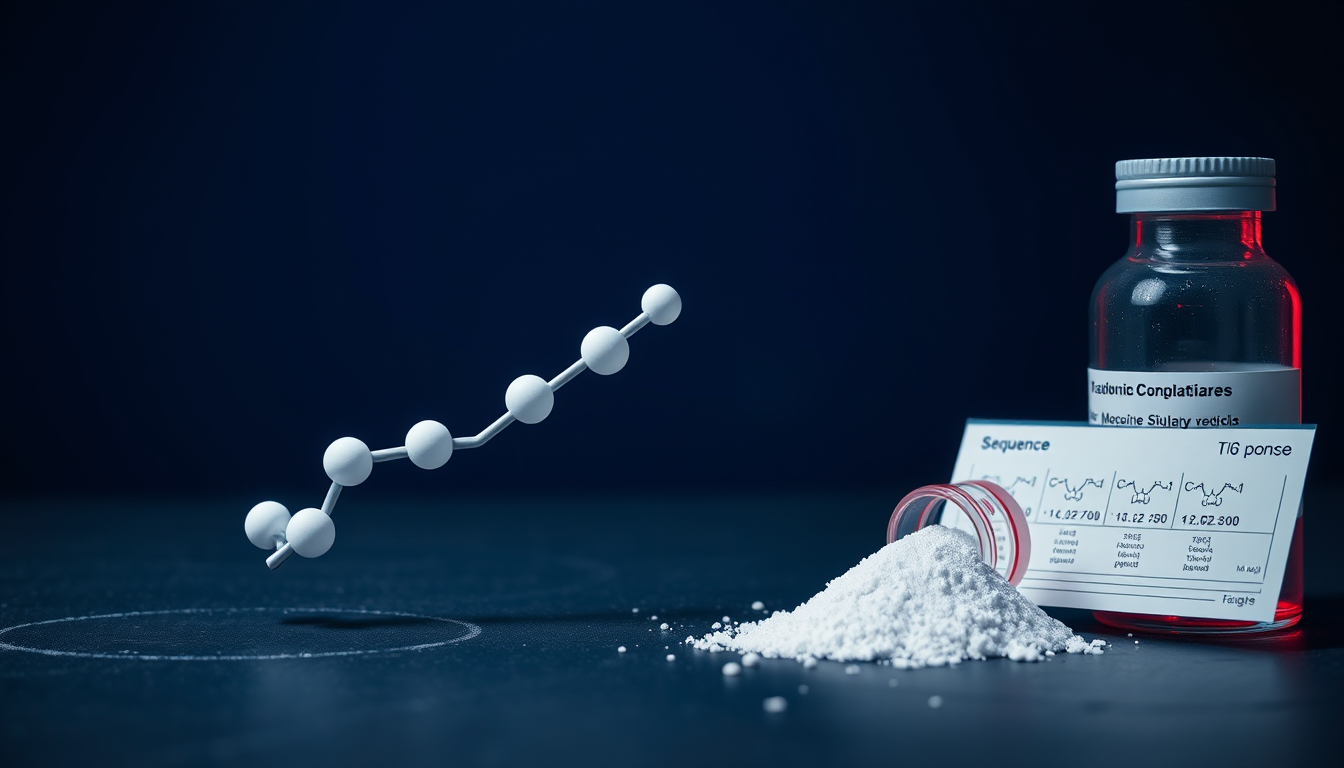
A peptide is a molecule made of two or more amino acids linked end to end by peptide bonds. The National Human Genome Research Institute glossary puts the typical range at 2 to 50 residues; chains longer than that are usually called polypeptides, and one or more folded polypeptides make a protein. The boundary is a convention rather than a law of chemistry, but it is a useful one for a research buyer because almost everything in a research-peptide catalog falls inside it.
The word "residue" is worth fixing early. When two amino acids join, a molecule of water is lost, so what remains of each amino acid inside the chain is slightly smaller than the free amino acid. Chemists call that remaining unit a residue. A pentadecapeptide such as BPC-157 therefore contains fifteen residues, not fifteen intact amino acids, and its molecular weight is the sum of fifteen residue masses plus one water.
Peptides occupy a middle ground in molecular size. A small-molecule drug such as aspirin has a mass near 180 daltons. A dipeptide such as glycylglycine (PubChem CID 11163) weighs 132 daltons. A 43-residue chain such as thymosin beta-4 is near 4,963 daltons, and an antibody is roughly 150,000. Reviews of peptide drug discovery, including the 2021 Nature Reviews Drug Discovery survey by Muttenthaler and colleagues, describe this middle ground as the reason peptides are studied at all: they are large enough to cover a receptor surface with many contact points, yet small enough to be made by chemical synthesis rather than by living cells.
Amino acids: one shared backbone, twenty different side chains
Every proteinogenic amino acid shares the same core: a central alpha carbon bonded to an amino group, a carboxyl group, a hydrogen atom, and a variable side chain. The twenty standard side chains are what give each residue its character. Glycine's side chain is a single hydrogen, which makes it unusually flexible. Proline's side chain loops back onto the backbone nitrogen, which locks the chain into a kink. Lysine and arginine carry a positive charge at neutral pH; aspartate and glutamate carry a negative one. Leucine, isoleucine, valine, and phenylalanine are oily and avoid water. Cysteine carries a thiol that can pair with another cysteine to form a disulfide bridge, and methionine carries a sulfur that oxidizes readily.
All of the standard amino acids except glycine are chiral, meaning they exist in two mirror-image forms. Ribosomes build proteins exclusively from the L-form. Synthetic peptides can incorporate D-amino acids deliberately, and several compounds in the research literature do so because a D-residue resists the enzymes that would normally cut the chain. The convention matters for analytics as well: a mass spectrometer cannot distinguish a D-residue from an L-residue because they weigh the same, which is one reason a certificate of analysis reports identity by mass and purity by chromatography as separate lines (see LC-MS identity confirmation).
The side chains also set the practical lab properties of a peptide. A sequence rich in charged residues usually dissolves readily in water. A sequence rich in hydrophobic residues may need a co-solvent or a pH adjustment to go into solution, and it will adsorb more readily to plastic surfaces. These behaviors are predictable from the sequence alone, which is why a lab reads the sequence before opening the vial.
The peptide bond is a rigid, planar amide link
The peptide bond forms when the carboxyl carbon of one amino acid bonds to the amino nitrogen of the next, releasing water. The product is an amide, and amides are not ordinary single bonds. In their 1951 Proceedings of the National Academy of Sciences paper, Pauling, Corey, and Branson built their models of the alpha helix and related structures on the observation that the carbon-nitrogen bond in an amide has partial double-bond character because electrons from the adjacent carbonyl oxygen are shared across it. The consequence is that the six atoms around a peptide bond lie in one plane and the bond does not rotate freely.
That rigidity is the single most important fact about peptide structure. Because the amide plane is fixed, a chain can only change shape by rotating about the two bonds on either side of each alpha carbon, conventionally called phi and psi. Those two angles per residue, plus the side chains, define every conformation a peptide can adopt. Nearly all peptide bonds sit in the trans arrangement, with the two alpha carbons on opposite sides of the bond; the exception is the bond preceding a proline residue, which adopts the cis form often enough to produce slowly interconverting populations that can appear as split or broadened peaks on a chromatogram.
| Feature of the peptide bond | What it means in practice |
|---|---|
| Partial double-bond character (C-N about 1.33 angstroms) | No free rotation; the amide group is planar |
| Trans geometry preferred | Adjacent side chains point in alternating directions along the chain |
| Cis form possible before proline | Proline-rich sequences (such as BPC-157) can show conformer peaks in HPLC |
| Hydrolyzable by water, acid, base, and proteases | Peptides in solution degrade over time; lyophilized powder is the stable shipping form |
| Loss of one water per bond formed | Molecular weight equals sum of residue masses plus 18 daltons |
Peptide, polypeptide, protein: where the lines are drawn
The difference between a peptide and a protein is mostly a difference of length and folding. A peptide of a dozen residues is usually too short to hold a stable three-dimensional shape on its own; it flickers among many conformations in water and may only settle into a defined shape when it meets a receptor or a membrane. A protein of several hundred residues folds into a specific, stable structure dictated by its sequence. Anfinsen's 1973 Science paper set out the principle that the information needed for that fold is contained in the sequence itself.
In between sits a gray zone. Insulin, at 51 residues in two chains, is routinely called both a peptide and a protein. Thymosin beta-4, at 43 residues, is called a peptide in most papers but adopts two helices in a membrane-mimicking solvent. IGF-1 LR3, at 83 residues, is a small protein by any reasonable definition even though it appears in peptide catalogs. The table below places several catalog compounds on the length scale.
| Compound | Residues | Class by convention | Approximate mass (daltons) |
|---|---|---|---|
| Glycylglycine | 2 | Dipeptide | 132 |
| GHK (glycyl-histidyl-lysine) | 3 | Tripeptide | 340 |
| Semax, Selank | 7 | Heptapeptide | 813, 751 |
| BPC-157 | 15 | Pentadecapeptide | 1,419 |
| Thymosin beta-4 | 43 | Peptide or small protein | 4,963 |
| IGF-1 LR3 | 83 | Small protein | 9,100 |
For a buyer the distinction has a practical edge. Short peptides are synthesized chemically, residue by residue, and their certificates report a single expected mass. Longer chains are often made by recombinant expression in cells, and their certificates look more like protein data sheets, with notes on folding, aggregation, and host-cell impurities.
Why sequence sets behavior
Two peptides of identical length and nearly identical composition can behave as different molecules because order matters. Semax and Selank are both seven-residue chains built from common amino acids, yet one is derived from a fragment of adrenocorticotropic hormone and the other from the immune tetrapeptide tuftsin, and the published literature on each describes different cellular targets. The sequence is the molecule's address: it determines which residues face outward, which receptor pocket the chain can fit, which bonds a protease can reach, and whether the chain can form a helix at all.
Sequence also determines chemical stability. A methionine residue gives a peptide a site that oxidizes in air to a sulfoxide; thymosin beta-4 contains one at position 6, and a 1994 European Journal of Biochemistry study showed that the sulfoxide form almost loses its actin-binding function. An asparagine followed by glycine is prone to deamidation. Aspartate-proline bonds hydrolyze faster than most. A lab that knows these rules can predict which impurity peaks to expect on a chromatogram and how a solution will age. Our article on reading a peptide sequence walks through the notation, including end-caps and D-residues, in more detail.
Finally, sequence sets the terms of synthesis. Solid-phase peptide synthesis, described by Merrifield in his 1986 Science Nobel lecture, adds residues one at a time to a chain anchored on a resin bead. Each coupling step is slightly less than perfect, so the longer the chain, the larger the fraction of molecules that are missing a residue. That is why purity by HPLC is reported for every lot and why the number tends to be harder to reach for long sequences than for short ones.
Why chain length matters beyond mass
Chain length changes four things at once: conformational freedom, resistance to enzymes, synthetic difficulty, and the way the molecule crosses or fails to cross a membrane. Very short peptides are flexible and bind their targets by induced fit, which often means lower affinity but faster association. Chains of twenty to forty residues can hold a helix or a hairpin, which raises affinity and selectivity. Craik and colleagues, writing in Chemical Biology and Drug Design in 2013, and Lau and Dunn in Bioorganic and Medicinal Chemistry in 2018, both frame peptide design as a search for the shortest chain that still holds the active shape, because every added residue costs synthetic yield and adds a potential cleavage site.
Length also drives the counter-ion and water content of a lyophilized powder. Each basic residue in a sequence carries a counter-ion in the solid, typically acetate or trifluoroacetate, and the powder holds a few percent of bound water. A longer, more basic sequence therefore has a larger gap between its gross weight and its net peptide content. This is why a certificate reports purity and net content as separate numbers, a topic covered in net peptide content vs purity and in milligrams, micrograms, and molarity.
Frequently Asked Questions
What is the difference between a peptide and a protein?
Both are chains of amino acids joined by peptide bonds. By convention, chains of about 2 to 50 residues are called peptides and longer chains are polypeptides; a protein is one or more polypeptides folded into a stable three-dimensional shape. Short peptides are usually too small to hold a stable fold on their own.
How many amino acids are in a peptide?
At least two, and by common definition up to about 50. A dipeptide has two residues, a tripeptide three, and so on. Research catalogs span the whole range, from tripeptides such as GHK to 43-residue chains such as thymosin beta-4 and 83-residue proteins such as IGF-1 LR3.
What is a peptide bond made of?
A peptide bond is an amide bond between the carboxyl carbon of one amino acid and the amino nitrogen of the next, formed with loss of one water molecule. Because the carbonyl oxygen shares electrons across the carbon-nitrogen bond, the bond is planar and does not rotate, which constrains the shapes a chain can adopt.
Why do two peptides with the same amino acids behave differently?
Because the order of residues determines which groups face outward, which receptor pocket the chain can fit, and which bonds enzymes can reach. Sequence also sets chemical stability, solubility, and the ease of synthesis, so two chains with the same composition but different order are different molecules.
Citations
- Pauling L, Corey RB, Branson HR. The structure of proteins; two hydrogen-bonded helical configurations of the polypeptide chain. Proc Natl Acad Sci U S A. 1951;37(4):205-211. PMID 14816373
- Anfinsen CB. Principles that govern the folding of protein chains. Science. 1973;181(4096):223-230. PMID 4124164
- Merrifield B. Solid phase synthesis. Science. 1986;232(4748):341-347. PMID 3961484
- Craik DJ, Fairlie DP, Liras S, Price D. The future of peptide-based drugs. Chem Biol Drug Des. 2013;81(1):136-147. PMID 23253135
- Muttenthaler M, King GF, Adams DJ, Alewood PF. Trends in peptide drug discovery. Nat Rev Drug Discov. 2021;20(4):309-325. PMID 33536635
- Lau JL, Dunn MK. Therapeutic peptides: Historical perspectives, current development trends, and future directions. Bioorg Med Chem. 2018;26(10):2700-2707. PMID 28720325
- Heintz D, Reichert A, Mihelic-Rapp M, et al. The sulfoxide of thymosin beta 4 almost lacks the polymerization-inhibiting capacity for actin. Eur J Biochem. 1994;223(2):345-350. PMID 8055902
- National Human Genome Research Institute. Talking Glossary of Genomic and Genetic Terms: Peptide. genome.gov
- PubChem. Glycylglycine, CID 11163. National Library of Medicine. pubchem.ncbi.nlm.nih.gov
This article is for laboratory research reference only. US Prime Peptides products are supplied strictly for in vitro research. Not for human consumption.
Related research
- What Are Research Peptides? Grades, Formats, and How Labs Use Them
- TB-500 and Thymosin Beta-4: What the Research Literature Covers
- BPC-157: What the Published Research Covers
- Why Some Peptides Dissolve Badly: Hydrophobicity, Aggregation, and Net Charge
- NN9535 vs LY3298176 vs LY3437943: Receptor Profiles and Structures Compared
Compliance Notice: US Prime Peptides products are supplied strictly for laboratory and academic research purposes only. They are not intended for human or veterinary consumption, diagnosis, treatment, or prevention of any disease. All content on this page is educational in nature and does not constitute medical advice or product claims. Researchers are responsible for handling these compounds in accordance with their institution’s safety protocols and applicable laws.