Research-use-only context. This article summarizes published third-party scientific literature and laboratory practice. It is not medical advice, not a therapeutic or performance claim, and not a usage guide. US Prime Peptides products are supplied strictly for in vitro laboratory research and are not for human or veterinary use.
This article defines the research-peptide category and sets it next to the other grades a buyer will encounter: drug-grade active ingredients, compounded preparations, and cosmetic raw materials. It also covers the physical formats research peptides ship in, the kinds of laboratory work they support, and what the "research use only" label obligates the buyer to do.
Research peptides are synthetic chemicals sold for laboratory work, not drugs
A research peptide is a chemically synthesized amino acid chain supplied as a reference chemical for in vitro laboratory study, labeled "for research use only," and sold outside the drug supply chain. It is not an approved drug, not a compounded preparation, and not a dietary ingredient. The label is a statement about intended use: the vendor is supplying a characterized chemical for experiments in cell culture, receptor assays, analytical method development, and similar bench work, and the buyer agrees to keep it there.
The phrase comes from the FDA's labeling rule for in vitro diagnostic products, 21 CFR 809.10(c)(2)(i), which requires products in the laboratory research phase to carry the statement "For Research Use Only. Not for use in diagnostic procedures." The agency's 2013 guidance on RUO and IUO products explains that the label is only honest if the manufacturer's conduct matches it; a vendor cannot print RUO on a label and then market the product for a clinical purpose. Chemical suppliers of peptides adopted the same convention by analogy, and the FDA has applied the same intended-use logic to them. Our companion article on what research use only means covers the regulatory side in depth.
Most of the compounds in a research catalog are not approved drugs anywhere in the world. A few are: NN9535, LY3298176, TH9507, bremelanotide, and oxytocin all exist as approved drug products under other names. A research vial of the same sequence is a different article of commerce. It has not gone through the drug approval process, carries no approved labeling, and is sold on the strength of its analytical certificate, not a clinical dossier.
How research grade differs from pharmaceutical, compounded, and cosmetic grades
The word "grade" describes the regulatory system a material was made under and the documentation that travels with it, not simply how pure it is. A research-grade lot can be chromatographically purer than a drug-grade lot; what it lacks is the drug-regulatory wrapper. The table summarizes the four categories a practice manager is likely to meet.
| Category | Who makes it | Regulatory basis | What the paperwork proves |
|---|---|---|---|
| Research grade (RUO) | Chemical synthesis vendors | Sold as a laboratory chemical with RUO labeling; no drug approval | Identity, purity, content, and contaminant panel on a certificate of analysis |
| Drug-grade active ingredient | Registered drug substance manufacturers | Drug manufacturing regulations; often a pharmacopeial monograph | Conformance to a drug specification plus a regulatory filing |
| Compounded preparation | 503A pharmacies and 503B outsourcing facilities | Sections 503A and 503B of the FD&C Act | A prescription or a prescriber's order; not approved by the FDA |
| Cosmetic raw material | Ingredient suppliers | Cosmetic ingredient rules; no pre-market approval | Supplier specification, often in a carrier or solution |
The FDA's own compounding pages make the key distinction clear: compounded drugs are not approved by the agency, 503A pharmacies work from prescriptions for identified individuals, and 503B outsourcing facilities register with the FDA and may supply office stock. None of that applies to a research vial. The FDA also maintains a list of bulk substances nominated for compounding that it declined to place in the permitted category; BPC-157, the thymosin beta-4 fragment sold as TB-500, GHK-Cu, Semax, Selank, and epitalon all appear there with the note that human safety data is lacking. A research vial of those sequences is a laboratory chemical, and the FDA's list is a useful reminder that the compounding route and the research route are separate.
Synthesis determines what a research peptide contains
Nearly every research peptide is made by solid-phase peptide synthesis, the method Merrifield described in his 1986 Nobel lecture: the chain is built one residue at a time on a resin bead, then cleaved off with strong acid and purified by preparative HPLC. Each step leaves a signature. Incomplete couplings produce deletion sequences one residue short. Incomplete deprotection leaves protecting groups attached. Acid cleavage can oxidize methionine or alkylate tryptophan. D'Hondt and colleagues catalogued these related impurities in a 2014 Journal of Pharmaceutical and Biomedical Analysis review, and the same impurity classes appear on research certificates as the minor peaks beside the main one.
The purification acid also leaves a trace. Trifluoroacetic acid is the standard HPLC modifier, and the finished powder usually carries trifluoroacetate as the counter-ion on every basic residue. Cornish and colleagues reported in 1999 that trifluoroacetate at the levels present in purified peptides inhibited proliferation of cultured osteoblasts and chondrocytes, which is why many cell-culture labs ask for acetate-exchanged material. Roux and colleagues evaluated exchange methods in a 2008 Journal of Peptide Science paper and found that complete removal is harder than it looks. The counter-ion is declared on a well-written certificate; our article on TFA salt vs acetate salt covers how to read that line.
Synthesis scale has its own consequences. Isidro-Llobet and colleagues, writing in the Journal of Organic Chemistry in 2019, describe how solvent use, coupling reagents, and purification steps scale with chain length, which explains why long sequences cost more per milligram and why purity targets are harder to hit for them. For a buyer the practical rule is simple: the sequence predicts the impurity profile, and the certificate should show that the vendor looked for it.
The formats a research peptide ships in
The default format is a lyophilized powder in a sealed glass vial. Freeze-drying removes water from a frozen solution by sublimation, leaving a porous cake that is far more stable than the same peptide in solution. Wang's 2000 review in the International Journal of Pharmaceutics lays out the physics: without bulk water, hydrolysis and deamidation slow dramatically, and the main remaining risks are residual moisture, oxidation, and heat. Manning and colleagues' 2010 update on protein stability adds that aggregation and oxidation remain live concerns even in the solid state, which is why vials are stored cold and kept sealed until use.
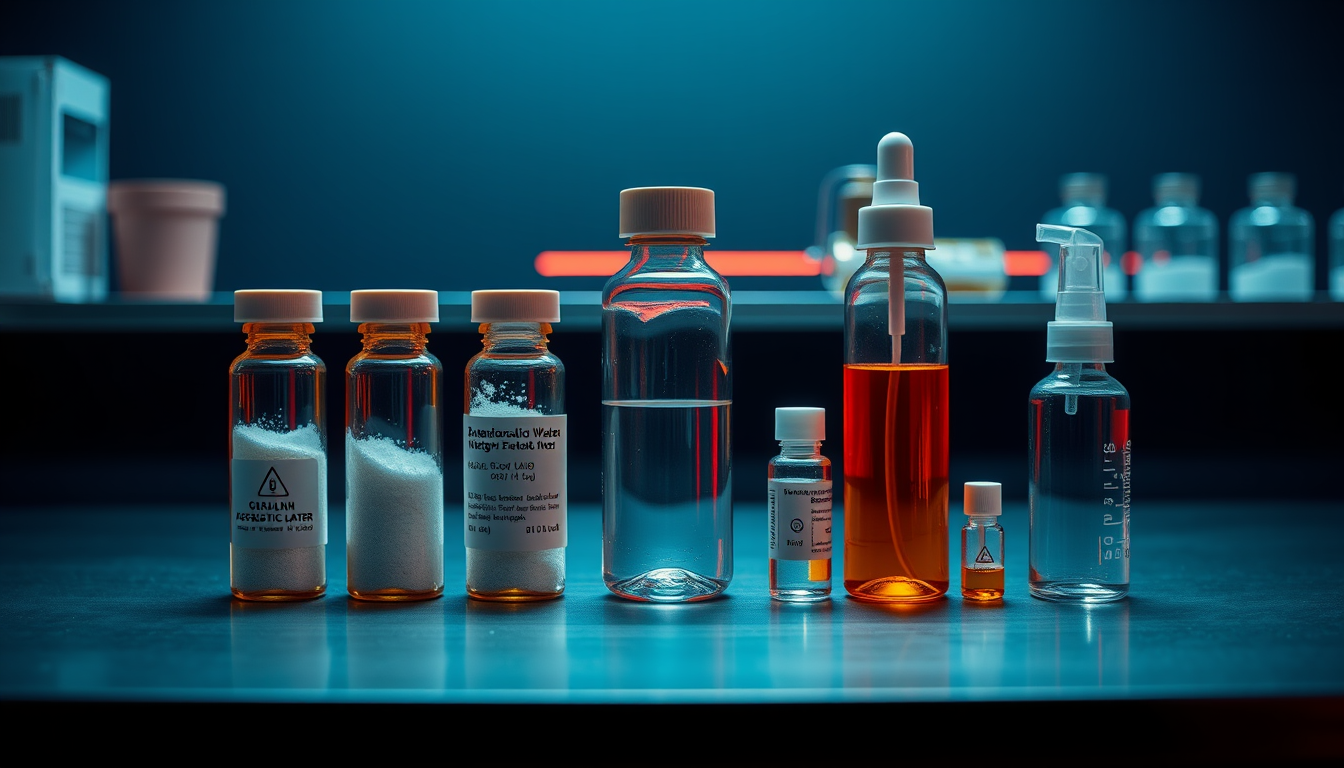
A research catalog usually carries more than vials. Liquid sprays are aqueous solutions of the peptide in a buffered, preserved matrix at a stated total mass per bottle. Dissolving strips are thin polymer films with a stated mass of peptide per strip. Bioregulators are the short Khavinson-type di-, tri-, and tetrapeptides, usually supplied as powders. Lab supplies round out the list: bacteriostatic water, which is sterile water with 0.9 percent benzyl alcohol as a preservative, reconstitution solution, and kits that bundle the diluent with consumables. Bacteriostatic Water 30 mL is listed with its own specification sheet so that a lab can cite the diluent lot alongside the peptide lot in a notebook.
Each format is documented differently. A vial certificate reports mass of peptide in the vial, purity by HPLC, identity by mass spectrometry, and a contaminant panel. A spray or strip certificate must add a content-per-unit line and a stability statement for the matrix. The comparison is laid out in vial, liquid spray, or dissolving strip.
What laboratories actually do with research peptides
In practice research peptides serve as defined chemical inputs to bench experiments. The most common uses in the published literature are receptor and binding assays, in which a peptide is applied to cultured cells or purified receptor preparations to measure signaling or affinity; cell-based functional assays such as migration, proliferation, tube formation, and gene-expression panels; analytical method development, where a characterized peptide serves as the reference standard for HPLC or LC-MS methods; and stability studies that track how a sequence degrades under heat, light, pH, or freeze-thaw stress.
A second category is purely analytical. Doping-control laboratories, for example, synthesize or purchase reference peptides to build detection methods for products that appear on the market; the published work on the TB-500 fragment began that way. Forensic and quality-control labs do the same when they need to confirm what a seized or returned vial contains.
What a research peptide is not used for, under the RUO model, is anything that involves a person or an animal. The literature summaries on this site describe rodent and human studies because they exist in the published record, but those studies were run under their own regulatory frameworks by their own investigators. A research vial purchased from a chemical vendor supports the in vitro end of that work and nothing else.
What "research use only" obligates the buyer to do
The RUO label creates obligations on both sides of the transaction. The vendor must describe the product in chemical and analytical terms and must not market it with outcome claims. The buyer agrees, usually in a written attestation at account opening, to use the material only for in vitro research, not to resell it for other purposes, and to keep it out of any clinical or diagnostic workflow. The FDA's RUO guidance names user certification programs as one of the factors it considers when weighing whether a product's distribution matches its label, so the attestation is not a formality; it is part of what keeps the category honest.
For a practice buying under a physician-use account, the obligations translate into paperwork. Keep the lot-matched certificate for every vial, keep a storage log, keep the attestation on file, and keep the material separate, both on the shelf and in the records, from anything used in the care of people. The seven-item panel that US Prime Peptides posts for each lot, covering identity by mass spectrometry, purity by HPLC, net peptide content, endotoxin, sterility, heavy metals, and an independent third-party certificate, is designed to be filed that way. The BPC-157 10 mg listing shows what a lot-matched certificate looks like before purchase. How to read each line is covered in how to read a certificate of analysis.
Frequently Asked Questions
What does research grade mean for peptides?
It means the peptide was synthesized and sold as a laboratory chemical with "research use only" labeling, outside the drug supply chain. The grade describes the regulatory system and paperwork, not the purity number; a research-grade lot is documented by a certificate of analysis rather than a drug filing.
Are research peptides the same as pharmaceutical peptides?
No. A pharmaceutical peptide is a drug substance made under drug manufacturing regulations and tied to an approved or investigational product. A research peptide of the same sequence is a chemical reference material with no drug approval, no approved labeling, and no clinical dossier, even when the sequence matches an approved drug.
What formats do research peptides come in?
Most ship as lyophilized powder in sealed glass vials because the dry solid is far more stable than a solution. Catalogs also carry liquid sprays, dissolving strips, short bioregulator peptides, and lab supplies such as bacteriostatic water and reconstitution kits, each with its own certificate format.
What does a lab have to agree to when buying research peptides?
Buyers sign an attestation that the material will be used only for in vitro laboratory research, will not be resold for other purposes, and will stay out of any clinical or diagnostic workflow. The FDA counts such certification programs as one factor in judging whether a product's distribution matches its label.
Citations
- Merrifield B. Solid phase synthesis. Science. 1986;232(4748):341-347. PMID 3961484
- D'Hondt M, Bracke N, Taevernier L, et al. Related impurities in peptide medicines. J Pharm Biomed Anal. 2014;101:2-30. PMID 25044089
- Cornish J, Callon KE, Lin CQ, et al. Trifluoroacetate, a contaminant in purified proteins, inhibits proliferation of osteoblasts and chondrocytes. Am J Physiol. 1999;277(5):E779-E783. PMID 10567002
- Roux S, Zékri E, Rousseau B, et al. Elimination and exchange of trifluoroacetate counter-ion from cationic peptides: a critical evaluation of different approaches. J Pept Sci. 2008;14(3):354-359. PMID 18035848
- Isidro-Llobet A, Kenworthy MN, Mukherjee S, et al. Sustainability Challenges in Peptide Synthesis and Purification: From R&D to Production. J Org Chem. 2019;84(8):4615-4628. PMID 30900880
- Wang W. Lyophilization and development of solid protein pharmaceuticals. Int J Pharm. 2000;203(1-2):1-60. PMID 10967427
- Manning MC, Chou DK, Murphy BM, Payne RW, Katayama DS. Stability of protein pharmaceuticals: an update. Pharm Res. 2010;27(4):544-575. PMID 20143256
- Esposito S, Deventer K, Goeman J, Van der Eycken J, Van Eenoo P. Synthesis and characterization of the N-terminal acetylated 17-23 fragment of thymosin beta 4 identified in TB-500, a product suspected to possess doping potential. Drug Test Anal. 2012;4(9):733-738. PMID 22962027
- US Food and Drug Administration. Distribution of In Vitro Diagnostic Products Labeled for Research Use Only or Investigational Use Only: Guidance for Industry and FDA Staff (2013). fda.gov
- US Food and Drug Administration. Compounding and the FDA: Questions and Answers. fda.gov
- US Food and Drug Administration. Certain Bulk Drug Substances for Use in Compounding that May Present Significant Safety Risks. fda.gov
- Legal Information Institute. 21 CFR 809.10 Labeling for in vitro diagnostic products. law.cornell.edu
This article is for laboratory research reference only. US Prime Peptides products are supplied strictly for in vitro research. Not for human consumption.
Related research
- What 'Research Use Only' Actually Means on a Peptide Label
- Are Research Peptides Legal in the United States? What the Rules Actually Say
- What Is a Peptide? Amino Acids, Bonds, and Why Chain Length Matters
- TB-500 and Thymosin Beta-4: What the Research Literature Covers
- BPC-157: What the Published Research Covers
Compliance Notice: US Prime Peptides products are supplied strictly for laboratory and academic research purposes only. They are not intended for human or veterinary consumption, diagnosis, treatment, or prevention of any disease. All content on this page is educational in nature and does not constitute medical advice or product claims. Researchers are responsible for handling these compounds in accordance with their institution’s safety protocols and applicable laws.