Research-use-only context. This article summarizes published third-party scientific literature and laboratory practice. It is not medical advice, not a therapeutic or performance claim, and not a usage guide. US Prime Peptides products are supplied strictly for in vitro laboratory research and are not for human or veterinary use.
US Prime Peptides supplies research peptides to physicians' practices, clinics, and laboratories under a physician-use, research-use-only model. This article explains how an order works from the entry confirmation to the box on the bench: who the account model is for, what the catalog contains, how lot-matched certificates are posted before purchase, what the seven-layer testing standard covers, how fulfillment and shipping are handled, and what a person on the support line can and cannot help with.
The short answer: confirm eligibility, review the certificate, order, receive
Ordering from US Prime Peptides is a four-step process. A buyer confirms on entry that they are a licensed practitioner or otherwise qualified purchaser acquiring materials for research use only. They browse a catalog where every product page carries the lot-matched certificate of analysis for the lot currently shipping, so the analytical record is read before anything is paid for. They check out through an account or as a guest, with the same confirmation either way. The order is packed and shipped from the United States with 2-Day service included, and a person answers any question about documentation, lots, or the order itself.
Nothing in that sequence involves a prescription, a pharmacy, or a compounded preparation, and nothing about it changes what the material is: a laboratory reagent sold for in vitro work. The rest of this article takes each step in turn and explains why it is designed the way it is.
The physician-use account and the entry confirmation
The physician-use model means that products are supplied to licensed practitioners, clinics, and qualified purchasers such as laboratories, not to the general public, and that every buyer makes an affirmative statement about who they are and what the materials are for. On entry and again at purchase, the buyer certifies that they are a licensed practitioner or otherwise qualified purchaser, that the products are for research use only, and that they are not for human or veterinary use. The confirmation is a statement of intended use made by the buyer, and it is kept with the order record.
The reason a supplier asks is the one explained in our article on what "research use only" means: under federal law, whether a peptide is a laboratory chemical or an unapproved drug depends on intended use, and the supplier's obligation is to label, market, and sell consistently with research use. The entry confirmation is the buyer's half of that consistency. An account is useful for a practice or a laboratory because it keeps order history, lot numbers, and certificates in one place for the lab's own document control, but an account is not required; guest checkout exists for a one-off purchase and carries the same confirmation. Either way, the supplier sells the same materials under the same terms.
The catalog: formats, label masses, and what a product page states
The catalog is organized by format. Lyophilized vials make up most of it, labeled by the mass of peptide in the vial, from single compounds to multi-peptide blends. Liquid sprays and dissolving strips are listed separately because their chemistry, stability, and documentation differ from a dry powder; the Khavinson-type bioregulator peptides have their own section; and lab supplies, including bacteriostatic water, reconstitution solution, and a reconstitution kit, are listed so that a laboratory can order consumables alongside the peptides they will be used with.
A product page states the compound name and any common synonyms, the labeled mass, the format, the storage condition, and the research-use-only designation. It also states regulatory context where it matters. For an investigational compound such as LY3437943 10 mg, the page is explicit that the vial is a research reagent documented by its certificate, not the investigational drug product studied in clinical trials, and the same distinction is stated for every compound in the catalog that exists as an approved or investigational drug. For a widely studied compound with no approval anywhere, such as BPC-157 10 mg, the page links the published research overview and the certificate. For a blend such as Wolverine 10 mg / 10 mg, the certificate reports each component separately, which is the standard a multi-peptide certificate has to meet.
Lot-matched certificates before purchase, and the seven-layer testing standard
Every lot that US Prime Peptides releases is tested on seven lines, and the certificate reporting those results is posted on the product page, matched to the lot number that will ship, before the buyer places an order. The point of posting it in advance is simple: the certificate is the evidence, and the buyer should be able to evaluate the evidence before, not after, paying. The table lists the seven layers and the question each answers.
| Layer | Method | Question it answers |
|---|---|---|
| 1. Identity | Mass spectrometry | Is the observed mass the expected mass for this sequence? |
| 2. Purity | HPLC, 99% or higher | What fraction of the peptide-containing material is the target peptide? |
| 3. Net peptide content | Quantitative assay | How much of the vial's mass is peptide, as opposed to counter-ion and water? |
| 4. Endotoxin | LAL (Limulus amebocyte lysate) | Is bacterial endotoxin below the stated limit per milligram? |
| 5. Sterility | Compendial sterility method | Did the tested units show microbial growth? |
| 6. Heavy metals | ICP-MS | Are elemental impurities below the stated limits? |
| 7. Independent certificate | Third-party US laboratory | Does a laboratory with no stake in the sale confirm the lot? |
Lines one through three describe the chemistry of the lot; lines four through six describe what is not in it; line seven is about who is doing the describing. Our guide to reading a certificate line by line explains each field, and a separate article explains why an independent second laboratory changes the weight of a report. The independent-laboratory requirement reflects a pattern the published literature has documented repeatedly: a 2010 Drug Testing and Analysis paper identified an undeclared growth hormone releasing peptide in a product sold as a supplement; a 2014 European Journal of Clinical Pharmacology study of black-market products seized in Germany found peptide preparations whose labels and contents disagreed; and a 2024 Journal of Medical Internet Research surveillance study of NN9535 sold online without a prescription found quality and labeling failures across sellers. A manufacturer's own certificate cannot resolve that problem on its own; a second, independent report can.
Checkout, US fulfillment, and shipping
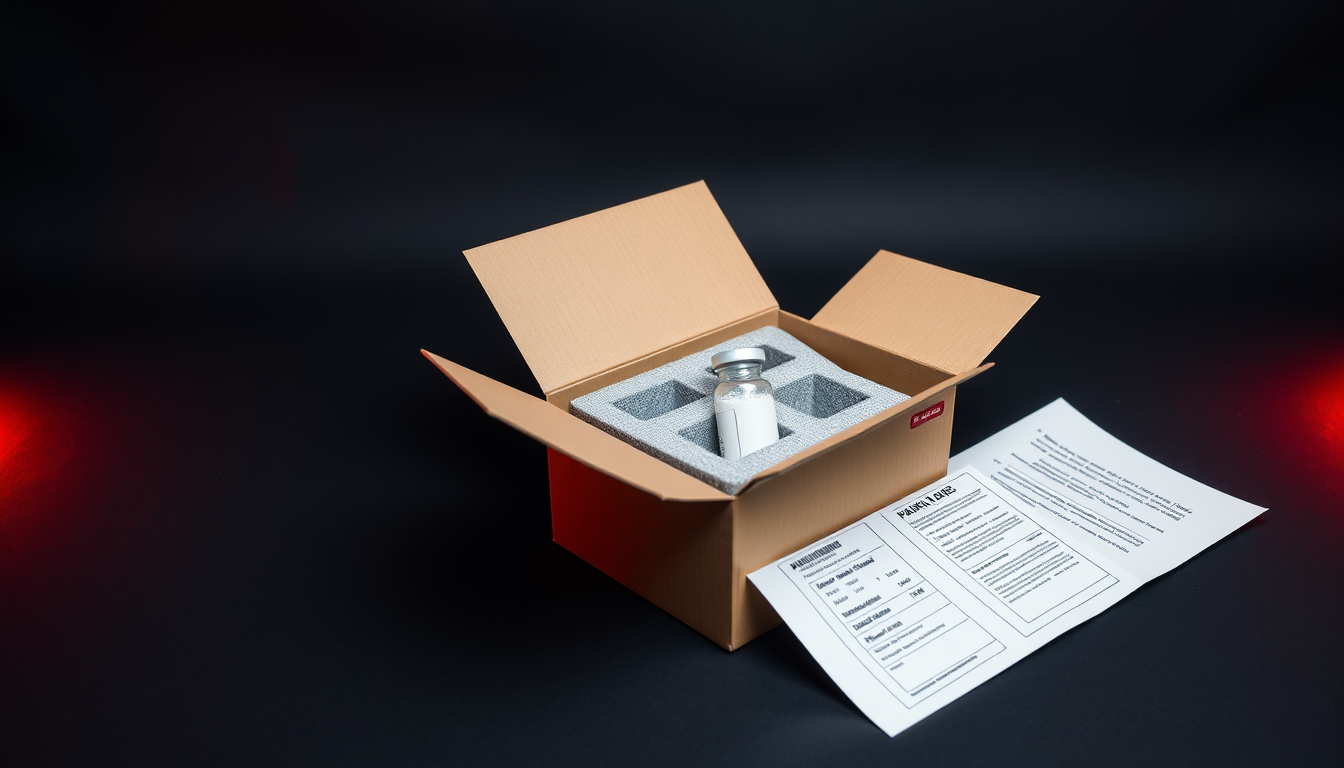
Checkout works the same way for an account holder and a guest: the confirmation, the order, and a receipt that lists each product with its lot number. Orders are fulfilled from the United States. Shipping is $12.99 per order and free on orders over $1,000, and 2-Day service is included rather than sold as an upgrade, because a short, predictable transit window is the single most effective thing a shipper can do for a temperature-sensitive package. Lyophilized vials travel as dry solids in a protective insert inside a plain carton; aqueous formats are assessed for coolant on a format and season basis. The packing slip repeats each lot number so the receiver can match vials to certificates, and our article on how an order is packed and shipped walks through the process and a receiving checklist.
The provenance statement that applies to the catalog is deliberately precise: products are synthesized and lyophilized in the USA and tested by an independent US laboratory. That statement is made at the level of process steps rather than as an unqualified origin claim, and the reasons are explained in a separate article on what "made in the USA" means for a research peptide.
Support answered by a person, and what a practice should keep on file
Questions about an order, an account, a lot, or a document are answered by a person, not an automated system. Typical requests are copies of a certificate for a lot received some time ago, confirmation that a lot number on a vial matches the posted certificate, documentation a laboratory needs for its own records, status on a shipment, and corrections to an order. Support does not provide protocols or guidance on use in people or animals, because the products are not supplied for that purpose; a question of that kind receives the research-use-only answer and nothing more.
For a practice or a laboratory, the paperwork that matters is modest but worth keeping together: the entry confirmation and account record, each invoice and packing slip, the lot-matched certificate for every lot received, and a receiving log noting date, condition, and storage location. Compounders are required by statute to hold a valid certificate of analysis for each bulk substance they use, and the peer-reviewed compounding literature on qualifying suppliers, such as a 2023 International Journal of Pharmaceutical Compounding article, describes the same discipline: know the source, hold the certificate, match the lot. A research laboratory is not a compounder and is not under that statute, but the same record-keeping is what makes a research reagent traceable and is what any later audit or inquiry will ask to see.
Frequently Asked Questions
Who can order from US Prime Peptides?
Licensed practitioners, clinics, and otherwise qualified purchasers such as laboratories, buying materials for research use only. Every buyer confirms that status on entry and at purchase, and products are not supplied to the general public or for human or veterinary use.
Do I need an account to order research peptides from US Prime?
No. Guest checkout is available and carries the same eligibility and research-use confirmation. An account is useful for a practice or a lab because it keeps order history, lot numbers, and certificates in one place for document control.
Can I see the certificate of analysis before I buy?
Yes. Each product page posts the lot-matched certificate for the lot currently shipping, covering mass spectrometry identity, HPLC purity of 99% or higher, net peptide content, LAL endotoxin, sterility, ICP-MS heavy metals, and an independent third-party laboratory's report.
How much is shipping and how fast does it arrive?
Shipping is $12.99 per order and free on orders over $1,000. Orders are fulfilled from the United States with 2-Day service included, and the packing slip lists each product's lot number so vials can be matched to their certificates on arrival.
Citations
- US FDA. Compounding and the FDA: Questions and Answers (compounded drugs are not approved by the FDA; 503A versus 503B oversight). fda.gov
- US FDA. Bulk Drug Substances Used in Compounding Under Section 503A of the FD&C Act (certificate of analysis and registered-source requirements). fda.gov
- 21 U.S.C. 353a, Pharmacy compounding. Legal Information Institute, Cornell Law School. law.cornell.edu
- Federal Trade Commission. Complying with the Made in USA Standard. ftc.gov
- Thomas A, Kohler M, Mester J, et al. Identification of the growth-hormone-releasing peptide-2 (GHRP-2) in a nutritional supplement. Drug Test Anal. 2010;2(3):144-148. PMID 20878896
- Krug O, Thomas A, Walpurgis K, et al. Identification of black market products and potential doping agents in Germany 2010-2013. Eur J Clin Pharmacol. 2014;70(11):1303-1311. PMID 25168622
- Ashraf AR, Mackey TK, Vida RG, et al. Multifactor Quality and Safety Analysis of NN9535 Products Sold by Online Sellers Without a Prescription: Market Surveillance, Content Analysis, and Product Purchase Evaluation Study. J Med Internet Res. 2024;26:e65440. PMID 39509151
- Summers A. Considerations in Qualifying Critical Suppliers. Int J Pharm Compd. 2023;27(6):461-466. PMID 38100663
- Judák P, Esposito S, Coppieters G, Van Eenoo P, Deventer K. Doping control analysis of small peptides: A decade of progress. J Chromatogr B Analyt Technol Biomed Life Sci. 2021;1173:122551. PMID 33848801
This article is for laboratory research reference only. US Prime Peptides products are supplied strictly for in vitro research. Not for human consumption.
Related research
- Why a Second Laboratory Matters: Independent Testing vs Manufacturer Certificates
- How to Vet a Research Peptide Vendor: A 12-Point Checklist
- What 'Research Use Only' Actually Means on a Peptide Label
- Are Research Peptides Legal in the United States? What the Rules Actually Say
- What a Lot Number Is For, and How to Match a Vial to Its Certificate
Compliance Notice: US Prime Peptides products are supplied strictly for laboratory and academic research purposes only. They are not intended for human or veterinary consumption, diagnosis, treatment, or prevention of any disease. All content on this page is educational in nature and does not constitute medical advice or product claims. Researchers are responsible for handling these compounds in accordance with their institution’s safety protocols and applicable laws.