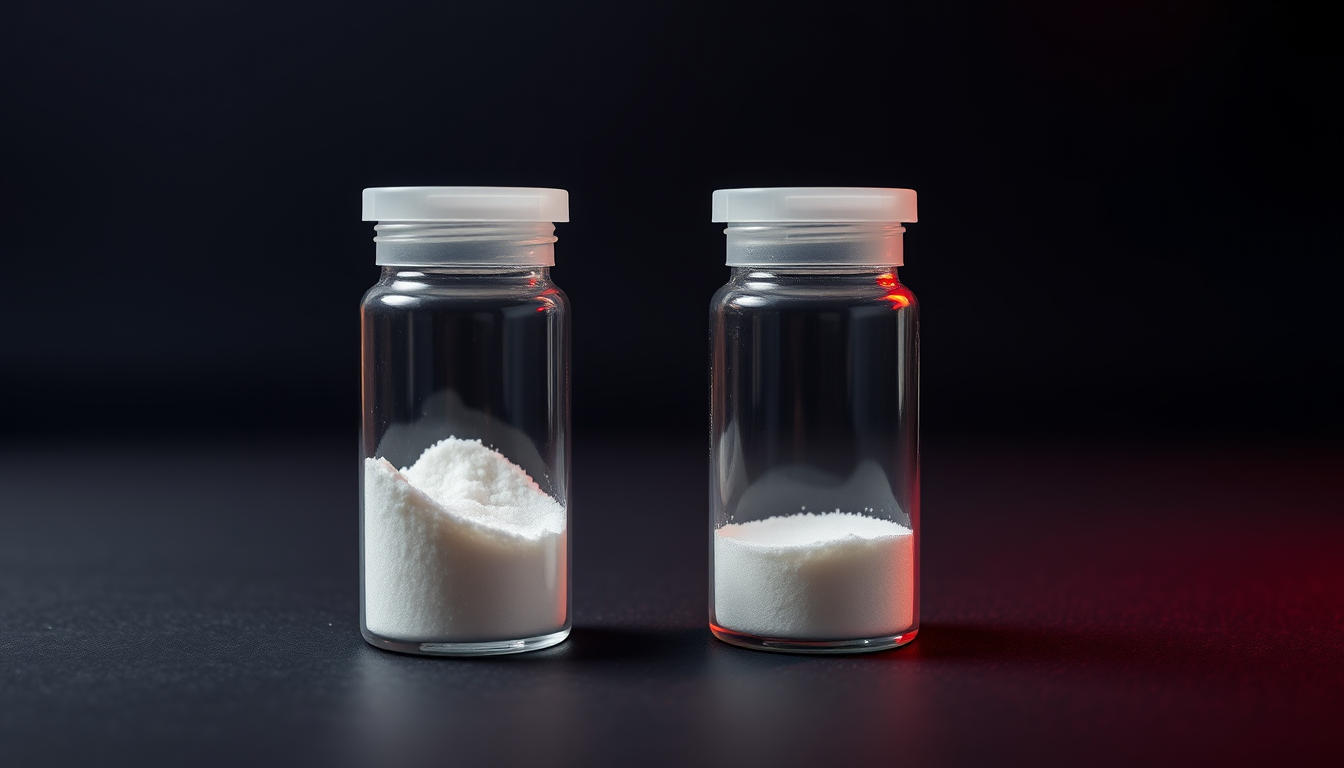
Research-use-only context. This article summarizes published third-party scientific literature and laboratory practice. It is not medical advice, not a therapeutic or performance claim, and not a usage guide. US Prime Peptides products are supplied strictly for in vitro laboratory research and are not for human or veterinary use.
Thymalin and thymosin alpha-1 are both described as "thymic peptides," and both trace back to acid extracts of calf thymus made in the 1970s. The resemblance ends there. This article explains why one of them has a defined 28-residue sequence and the other does not, how that difference changes what a certificate of analysis can say, where each stands with regulators, and how the two literatures differ in size and independence.
The short answer: a defined sequence versus an extract fraction
Thymosin alpha-1 is a single molecule: a 28-residue, N-acetylated, highly acidic peptide of mass 3,108 Da that was isolated from bovine thymosin fraction 5 and sequenced by Allan Goldstein's group in 1977. Thymalin is the name of a Russian preparation made by mild acid extraction of calf thymus; it is a polypeptide fraction, not one sequence, and its originating group has since identified two dipeptides, Glu-Trp and Lys-Glu, as its "active substances." A research vial labeled thymalin may therefore contain an extract, a defined synthetic dipeptide, or a defined mixture, and the certificate has to say which.
Thymosin alpha-1 is approved outside the United States as thymalfasin (trade name Zadaxin) and is not an approved drug in the US. Thymalin is registered in Russia and is not approved in the US. Neither research vial is the corresponding product. The compound-level articles on thymosin alpha-1 and thymalin cover each in more depth.
Thymosin alpha-1: a 28-residue fragment of prothymosin alpha
The sequence is Ac-Ser-Asp-Ala-Ala-Val-Asp-Thr-Ser-Ser-Glu-Ile-Thr-Thr-Lys-Asp-Leu-Lys-Glu-Lys-Lys-Glu-Val-Val-Glu-Glu-Ala-Glu-Asn-OH. With ten acidic residues and four lysines, it carries a strong net negative charge at neutral pH and an isoelectric point near 4.2, which is why it elutes early on reverse-phase HPLC and why it is usually supplied as an acetate salt. A 1984 review in Thymus by Low and Goldstein describes its purification from fraction 5 alongside thymosin beta-4, and a 1981 Molecular and Cellular Biochemistry paper by Hu, Low and Goldstein gives its molecular weight as 3,108.
It is not a gene product in its own right. A 1986 Proceedings of the National Academy of Sciences paper by Eschenfeldt and Berger cloned and sequenced human prothymosin alpha, a 111-residue protein with 54 acidic residues and no signal peptide, and showed that thymosin alpha-1 corresponds to positions 2 through 29 of it. Whether the 28-mer is a physiological cleavage product or an artifact of the acid-extraction method used to make fraction 5 has been debated since; what matters for a certificate is that the synthetic 28-mer, with its N-terminal acetyl group, is the molecule every published study since the 1980s has used.
No classical receptor has been identified. The best-characterized mechanistic work is in dendritic cells: a 2007 Annals of the New York Academy of Sciences review by Romani and colleagues summarizes their mouse studies showing Toll-like receptor and MyD88-dependent signaling in myeloid dendritic cells and TLR9/MyD88-dependent activation of plasmacytoid dendritic cells. A 2016 Vitamins and Hormones chapter by King and Tuthill reviews the same Toll-like receptor framework across preclinical and clinical data.
Thymalin: an extract whose composition is defined by its makers
The clearest primary description is a 1997 International Journal of Immunopharmacology paper by Morozov and Khavinson: natural thymic peptides were isolated from calf thymus by mild acid extraction, the resulting preparation was named Thymalin, and reversed-phase HPLC of Thymalin yielded the dipeptide L-Glu-L-Trp, which was then synthesized and marketed separately as Thymogen. The same paper introduces the synthetic dipeptide Vilon (Lys-Glu). A 2023 International Journal of Molecular Sciences paper by Linkova, Khavinson and colleagues states directly that "KE and EW dipeptides are active substances of Thymalin" and models their interaction with double-stranded DNA.
Published cell work on thymalin is recent and comes from the same group. A 2020 Bulletin of Experimental Biology and Medicine paper by Khavinson and colleagues exposed human hematopoietic stem cells in culture to thymalin and reported a two- to three-fold reduction in CD44 and CD117 expression and a 6.8-fold increase in CD28, which the authors read as differentiation toward mature T-lymphocyte markers. That is an in vitro flow-cytometry result from one laboratory and has not been independently replicated. The article on Khavinson short peptides covers the dipeptide family that grew out of this extract.
Side-by-side comparison
| Property | Thymalin | Thymosin alpha-1 |
|---|---|---|
| Origin | Mild acid extract of calf thymus (St Petersburg, 1970s); active components later identified as Glu-Trp and Lys-Glu | Isolated from bovine thymosin fraction 5 and sequenced in 1977 (Goldstein); residues 2-29 of prothymosin alpha |
| Sequence length | Not a single sequence; extract fraction. Component dipeptides are 2 residues (Glu-Trp about 333 Da; Lys-Glu about 275 Da) | 28 residues, defined |
| Mass | No single mass for the extract; defined dipeptide masses if a synthetic component is supplied | 3,108 Da (average) |
| Receptor or target class | None identified; DNA-interaction and differentiation-marker hypotheses from the originating group | None identified as a classical receptor; Toll-like receptor/MyD88 signaling in dendritic cells (mouse) |
| Modifications | None declared | N-terminal acetyl; free C-terminal acid |
| Regulatory status | Registered in Russia; not an approved drug in the US | Approved abroad as thymalfasin (Zadaxin) in more than 30 countries; not an approved drug in the US |
| Literature maturity | Soviet and Russian clinical reports; recent in vitro work from one group | Four decades of biochemistry, mouse immunology and multinational clinical trials from many groups |
The table shows the asymmetry that matters most for a buyer: thymosin alpha-1 can be specified, synthesized and verified as one molecule, while "thymalin" is a name whose chemical content depends on who made the vial.
How the certificates differ
A thymosin alpha-1 certificate looks like any other single-peptide certificate. The identity line should show multiply charged ions deconvoluting to 3,108 Da; a species at 3,066 Da indicates the deacetylated form and is a different molecule. HPLC purity should be a single dominant peak, and with no methionine, cysteine or tryptophan in the sequence there are no oxidation shoulders to look for; the main degradation route is deamidation at the C-terminal asparagine (+1 Da). Net peptide content matters because the acidic sequence binds a large counter-ion load. The article on LC-MS identity confirmation explains how to read the charge-state envelope on a peptide this size.
A thymalin certificate has to answer a prior question: what is being certified? If the vial contains an extract, mass spectrometry cannot give one identity, and the honest documentation is an HPLC fingerprint, an amino-acid composition and a total protein or peptide content, with the same endotoxin, sterility and metals panel as any other lot. If the vial contains a synthetic dipeptide or defined mixture standing in for the extract, the certificate should show that dipeptide's mass (333 Da for Glu-Trp) and say so on the label. US Prime Peptides states the declared composition on the product page for Thymalin 10 mg and posts the lot-matched certificate beside it, as it does for Thymosin Alpha-1 10 mg.
Regulatory status and the research-vial distinction
Thymosin alpha-1 was developed commercially by Alpha 1 Biomedicals and then SciClone, which launched it as Zadaxin; a 2002 Current Opinion in Investigational Drugs profile by Billich records that history, and a 2007 Annals of the New York Academy of Sciences overview by Garaci gives the longer scientific background from Goldstein's 1977 characterization onward. The international nonproprietary name is thymalfasin. It has never been approved by the FDA. Thymalin is a registered preparation in Russia under its own pharmacopoeial standard and has no US approval of any kind.
In both cases a lyophilized research vial is not the registered product. For thymosin alpha-1 the sequence is the same but the specification, manufacturing standard and intended use are not. For thymalin the research vial may not even be chemically the same thing as the Russian preparation. Both are supplied in the US only for in vitro laboratory work.
Frequently Asked Questions
Is thymalin the same as thymosin alpha-1?
No. Thymosin alpha-1 is a single defined 28-residue peptide of 3,108 Da. Thymalin is the name of a calf-thymus extract fraction whose originating group identifies two dipeptides, Glu-Trp and Lys-Glu, as its active components. They share a tissue of origin and nothing else.
Why does thymalin have no sequence?
Because it is defined by an extraction procedure, not by a structure. Mild acid extraction of calf thymus yields a mixture of polypeptides; the 1997 paper by Morozov and Khavinson describes isolating the dipeptide Glu-Trp from that mixture by HPLC. A certificate for an extract can report a fingerprint and composition but not one mass.
Is thymosin alpha-1 approved by the FDA?
No. Thymosin alpha-1 is approved abroad as thymalfasin (Zadaxin) in more than 30 countries but is not an approved drug in the United States. A research vial is not Zadaxin and is supplied only for in vitro use.
What should a thymosin alpha-1 certificate show?
An observed mass of 3,108 Da (not 3,066 Da, which is the deacetylated form), a single dominant HPLC peak, net peptide content, and the standard endotoxin, sterility and heavy-metals panel. Because the sequence has no Met, Cys or Trp, oxidation peaks should be absent.
Citations
- Low TL, Goldstein AL. Thymosins: structure, function and therapeutic applications. Thymus. 1984;6(1-2):27-42. PMID 6087503
- Hu SK, Low TL, Goldstein AL. Modulation of terminal deoxynucleotidyl transferase activity by thymosin. Mol Cell Biochem. 1981;41:49-58. PMID 7329413
- Eschenfeldt WH, Berger SL. The human prothymosin alpha gene is polymorphic and induced upon growth stimulation: evidence using a cloned cDNA. Proc Natl Acad Sci U S A. 1986;83(24):9403-9407. PMID 3467312
- Romani L, Bistoni F, Montagnoli C, et al. Thymosin alpha1: an endogenous regulator of inflammation, immunity, and tolerance. Ann N Y Acad Sci. 2007;1112:326-338. PMID 17495242
- King R, Tuthill C. Immune Modulation with Thymosin Alpha 1 Treatment. Vitam Horm. 2016;102:151-178. PMID 27450734
- Billich A. Thymosin alpha1. SciClone Pharmaceuticals. Curr Opin Investig Drugs. 2002;3(5):698-707. PMID 12090542
- Garaci E. Thymosin alpha1: a historical overview. Ann N Y Acad Sci. 2007;1112:14-20. PMID 17567941
- Morozov VG, Khavinson VK. Natural and synthetic thymic peptides as therapeutics for immune dysfunction. Int J Immunopharmacol. 1997;19(9-10):501-505. PMID 9637345
- Linkova N, Khavinson V, Diatlova A, et al. The Influence of KE and EW Dipeptides in the Composition of the Thymalin Drug on Gene Expression and Protein Synthesis Involved in the Pathogenesis of COVID-19. Int J Mol Sci. 2023;24(17):13377. PMID 37686182
- Khavinson VK, Linkova NS, Kvetnoy IM, et al. Thymalin: Activation of Differentiation of Human Hematopoietic Stem Cells. Bull Exp Biol Med. 2020;170(1):118-122. PMID 33237528
This article is for laboratory research reference only. US Prime Peptides products are supplied strictly for in vitro research. Not for human consumption.
Related research
- Thymalin: The Thymic Extract Peptide Complex in the Research Literature
- Thymosin Alpha-1: What the Research Literature Covers
- Pinealon (Glu-Asp-Arg): A Khavinson Tripeptide in the Research Literature
- Epithalon (Epitalon): The Tetrapeptide in the Research Literature
- Khavinson Short Peptides: Vilon, Vesugen, Testagen, and Prostamax Explained
Compliance Notice: US Prime Peptides products are supplied strictly for laboratory and academic research purposes only. They are not intended for human or veterinary consumption, diagnosis, treatment, or prevention of any disease. All content on this page is educational in nature and does not constitute medical advice or product claims. Researchers are responsible for handling these compounds in accordance with their institution’s safety protocols and applicable laws.