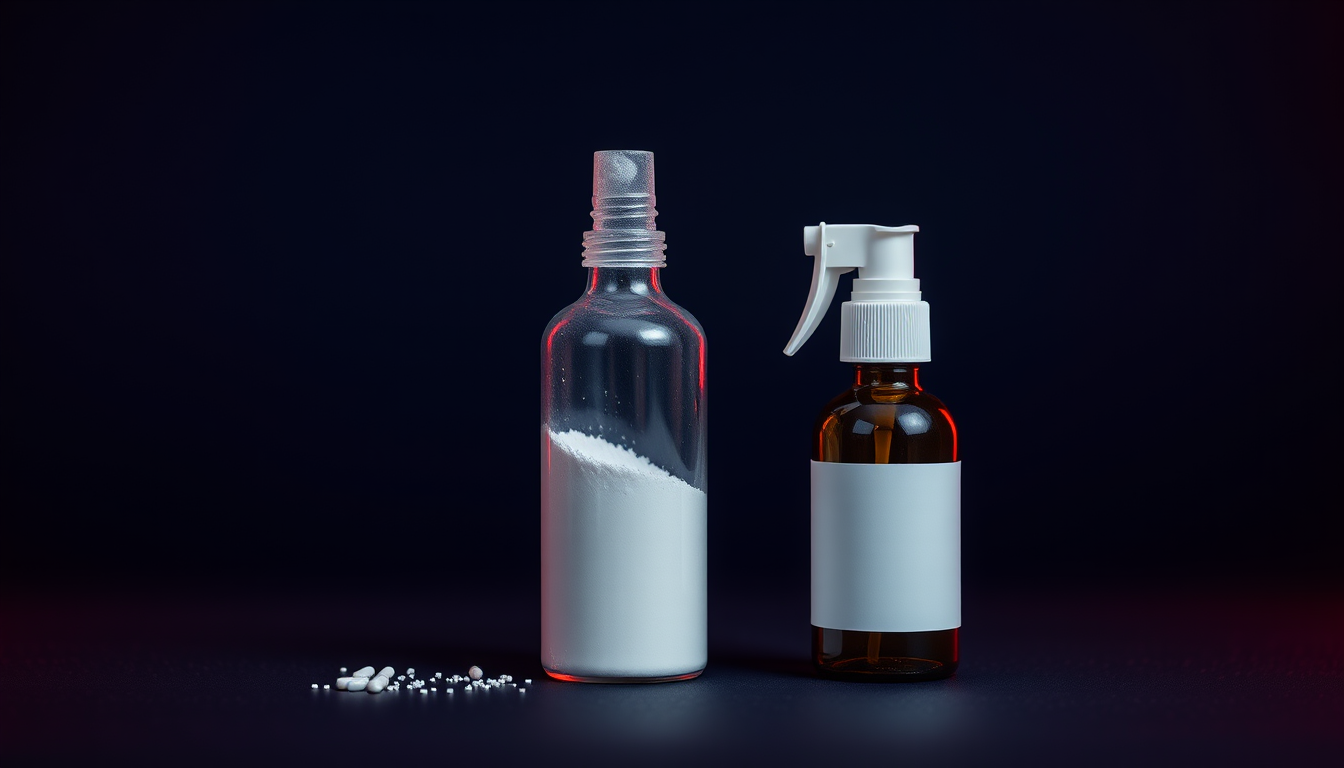
Research-use-only context. This article summarizes published third-party scientific literature and laboratory practice. It is not medical advice, not a therapeutic or performance claim, and not a usage guide. US Prime Peptides products are supplied strictly for in vitro laboratory research and are not for human or veterinary use.
This article compares NAD+ in three formats, a lyophilized vial, a dissolving strip, and a liquid spray, on the two things a research buyer can actually check: chemical stability and documentation. It explains why NAD+ hydrolyzes in water, which bond breaks, what the 1960s stability papers established, and how the label and certificate for each format should read.
The bond that sets NAD+ stability
NAD+ is not a peptide but a dinucleotide, and its weak point is the N-glycosidic bond between nicotinamide and the adjacent ribose. When that bond breaks, the molecule splits into nicotinamide and ADP-ribose, and the products no longer carry the redox-active pyridinium ring. Every stability question about NAD+ in any format comes back to how fast that bond cleaves.
The structure runs nicotinamide, ribose, pyrophosphate, ribose, adenine. The pyrophosphate linkage is comparatively robust; the nicotinamide-ribosyl bond is not, because the positively charged pyridinium ring is a good leaving group. Oppenheimer's 1994 review in Molecular and Cellular Biochemistry summarizes the evidence that both the chemical and the enzyme-catalyzed cleavage of that bond are dissociative, proceeding through an oxocarbenium ion intermediate on the ribose. That mechanism explains the pH sensitivity: conditions that stabilize the leaving group or the cation change the rate.
The practical consequence is that water is the reagent. A dry solid has almost none available; a film has a few percent, bound in polymer; a spray is nothing but water with solutes in it. The three formats are, in effect, three points on a water-activity scale, and NAD+ documentation should be read with that scale in mind (NAD+ chemistry and the research literature).
What the classic stability papers established
Three papers from the enzymology literature still define what is known about NAD+ stability in solution: the oxidized form is comparatively stable in acid and labile in base, the reduced form NADH is the reverse, and the identity of the buffer changes the rate independently of pH. Any certificate for an NAD+ solution should be read against those three findings.
Lowry, Passonneau, and Rock's 1961 paper in Journal of Biological Chemistry, titled simply "The stability of pyridine nucleotides," measured the loss of NAD+, NADH, NADP+, and NADPH across pH and temperature and reported the acid-stable, base-labile pattern for the oxidized forms and the opposite for the reduced forms, with rates rising steeply with temperature. Anderson and Anderson's 1963 paper in the same journal showed that the rate of NAD+ hydrolysis depended on which buffer was present, not only on the pH it held, a buffer-catalysis effect that a formulator cannot ignore.
Rover Júnior and colleagues revisited the question in 1998 in Analytical Biochemistry with a factorial design across buffer, pH, and temperature. Working mainly with the reduced form, they found faster degradation in phosphate buffer, attributed to adduct formation with the pyridine ring, and ranked the main effects as pH, then temperature, then buffer. The study is a reminder that phosphate, the most common laboratory buffer, is not a neutral choice for pyridine nucleotides.
| Paper | Model | Finding relevant to formulation |
|---|---|---|
| Lowry et al. 1961, J Biol Chem | Purified nucleotides in buffer | NAD+ stable in acid, destroyed in alkali; NADH the reverse; strong temperature dependence |
| Anderson & Anderson 1963, J Biol Chem | NAD+ in several buffers | Hydrolysis rate depends on buffer species, not pH alone |
| Oppenheimer 1994, Mol Cell Biochem | Mechanistic review | Nicotinamide-ribosyl cleavage is dissociative via an oxocarbenium intermediate |
| Rover Júnior et al. 1998, Anal Biochem | Factorial design, UV-visible | Phosphate accelerates degradation; pH, then temperature, then buffer are the main effects |
NAD+ in the lyophilized vial
A lyophilized vial such as NAD+ 1000 mg holds the compound as a dry solid, which is the most stable of the three states because the hydrolysis reaction has almost no water to run in. The label states total mass per vial, and the certificate verifies it with identity, purity, water content, and the nicotinamide line.
Wang's 2000 review in International Journal of Pharmaceutics and Carpenter and colleagues' 1997 practical guide in Pharmaceutical Research both make the general point for freeze-dried solids: chemical degradation is slowed by orders of magnitude when the matrix is a dry glass, and residual moisture is the single most important variable to control. NAD+ adds one complication: the solid is hygroscopic, so an opened vial picks up water from room air, and the stability of a stored solid depends on the seal, the desiccant, and the number of times the stopper has been breached.
The certificate lines to read are identity by mass spectrometry, purity by HPLC with nicotinamide and ADP-ribose resolved as named related substances, water content by Karl Fischer titration or loss on drying, and the form, since NAD+ is supplied as the free acid or as a salt and the label mass refers to the form stated. Endotoxin, sterility, and heavy metals complete a lot-matched panel.
NAD+ in a dissolving strip
A strip such as NAD+ dissolvable strips 100 mg per strip, 30 strips holds the compound in a dried water-soluble polymer film, which puts it between the vial and the spray on the water-activity scale. The label states mass per strip and strips per pack, and the certificate must add a content uniformity result.
At 100 mg per strip, NAD+ is a substantial fraction of the film's mass, not a trace solute, which changes the formulation. A hygroscopic active at high loading pulls water into the film, and the film's mechanical behavior and the compound's hydrolysis rate both follow that water. Hoffmann, Breitenbach, and Breitkreutz's 2011 review in Expert Opinion on Drug Delivery and Preis and colleagues' 2013 follow-up describe the characterization methods film laboratories use, including loss on drying, tensile testing, and in vitro disintegration, and note that these methods are not yet harmonized across pharmacopoeias.
Three lines distinguish a strip certificate from a vial certificate. Content uniformity under USP <905> shows that individual strips carry the labeled mass consistently. Assay is reported as a percentage of label claim rather than as area-percent purity, because the extracted sample is mostly polymer. And the nicotinamide line carries more weight than it does for the vial, because the film-casting step heats the compound in a wet matrix before drying, which is exactly the condition under which the nicotinamide-ribosyl bond cleaves (dissolving strips explained).
NAD+ in a liquid spray
A spray such as NAD+ liquid spray 500 mg holds the compound dissolved in a buffered, preserved aqueous vehicle, which is the least stable of the three states and the one where formulation choices matter most. The label states total mass per bottle with the fill volume, and the certificate verifies concentration by assay.
The 1961 and 1963 papers dictate the formulation. Because NAD+ is acid-stable and base-labile, the vehicle is buffered on the acidic side of neutral, and because buffer species change the rate, the buffer is chosen by stability data rather than habit, with phosphate handled cautiously after the 1998 findings. Refrigeration slows the reaction but does not stop it, so a spray has a defined shelf life and a shorter in-use period after first opening.
A multiple-entry aqueous container also needs a preservative. Meyer and colleagues' 2007 survey in Journal of Pharmaceutical Sciences and Stroppel and colleagues' 2023 overview in Pharmaceutics cover the choices and their compatibility problems, and USP <51> antimicrobial effectiveness testing is how the chosen system is qualified in the final vehicle. At 500 mg in a bottle, the solute itself also contributes measurably to osmolality, so the USP <785> value on the certificate reflects both the tonicity agent and the compound (inside a liquid spray).
The certificate lines to read are assay in mg/mL and as a percentage of label, nicotinamide as a percentage of the NAD+ peak, pH with the buffer named, osmolality, preservative identity and content, and the stability condition under which the shelf life was set, following ICH Q1A(R2).
Three formats side by side
Read on paper, the three formats differ in water activity, in the degradation marker that matters most, in the denominator of the label mass, and in the tests a certificate must carry. The table collects those differences in one place.
| Attribute | Lyophilized vial | Dissolving strip | Liquid spray |
|---|---|---|---|
| Physical state | Dry hygroscopic solid | Solid dispersed in a dried polymer film | Aqueous solution |
| Water available for hydrolysis | Residual moisture only | Bound water, a few percent | Bulk solvent |
| Label mass basis | mg per vial | mg per strip, strips per pack | mg per bottle, with fill volume |
| Primary assay line | HPLC purity plus water content | Assay as % of label claim; USP <905> | Assay in mg/mL; % of label claim |
| Degradation marker | Nicotinamide, usually low at release | Nicotinamide after casting | Nicotinamide, rising with time and temperature |
| Format-specific lines | Karl Fischer water, form (acid or salt) | Film mass, loss on drying, disintegration time | pH and buffer, osmolality, preservative content, USP <51> |
| Expected shelf-life ranking | Longest | Intermediate | Shortest, with an in-use period |
One practical rule follows for the receiving laboratory: log the arrival date, the storage condition, and every opening of the container for all three formats, because a certificate reports the lot at the moment of testing and nothing after it (peptide storage and stability).
Frequently Asked Questions
Why does NAD+ degrade in water?
The bond between nicotinamide and ribose is an N-glycosidic bond with a positively charged pyridinium leaving group, and in water it cleaves through an oxocarbenium intermediate to give nicotinamide and ADP-ribose. The rate rises with pH above neutral, with temperature, and with certain buffers, which is why a dry solid is far more stable than a solution.
Is NAD+ in a spray the same molecule as NAD+ in a vial?
The molecule is the same, but the product is not. The spray is a formulation in which NAD+ is dissolved in a buffered, preserved vehicle, so its certificate reports concentration, pH, osmolality, and preservative content, and its shelf life is shorter. Identity by mass spectrometry confirms the compound in both; everything else on the two certificates is read on different terms.
What does nicotinamide on an NAD+ certificate indicate?
Nicotinamide is the primary hydrolysis product of NAD+, so its level relative to the NAD+ peak is a direct measure of how much of the compound has degraded. A low value at release means the lot was dry or freshly formulated; a rising value on a stability pull means water, heat, or an unfavorable buffer has been at work.
Which NAD+ format has the longest shelf life?
The lyophilized vial, because hydrolysis needs water and a dry solid has almost none. A dissolving strip is intermediate, since its polymer holds a few percent of bound water. A liquid spray is the shortest-lived of the three and carries a separate in-use period after first opening. Exact figures come from each product's real-time stability data under ICH Q1A(R2) conditions.
Citations
- Lowry OH, Passonneau JV, Rock MK. The stability of pyridine nucleotides. J Biol Chem. 1961;236:2756-2759. PMID 14466980
- Anderson BM, Anderson CD. The effect of buffers on nicotinamide adenine dinucleotide hydrolysis. J Biol Chem. 1963;238:1475-1478. PMID 14012814
- Oppenheimer NJ. NAD hydrolysis: chemical and enzymatic mechanisms. Mol Cell Biochem. 1994;138(1-2):245-251. PMID 7898470
- Rover Júnior L, Fernandes JC, de Oliveira Neto G, Kubota LT, Katekawa E, Serrano SH. Study of NADH stability using ultraviolet-visible spectrophotometric analysis and factorial design. Anal Biochem. 1998;260(1):50-55. PMID 9648652
- Wang W. Lyophilization and development of solid protein pharmaceuticals. Int J Pharm. 2000;203(1-2):1-60. PMID 10967427
- Carpenter JF, Pikal MJ, Chang BS, Randolph TW. Rational design of stable lyophilized protein formulations: some practical advice. Pharm Res. 1997;14(8):969-975. PMID 9279875
- Hoffmann EM, Breitenbach A, Breitkreutz J. Advances in orodispersible films for drug delivery. Expert Opin Drug Deliv. 2011;8(3):299-316. PMID 21284577
- Preis M, Woertz C, Kleinebudde P, Breitkreutz J. Oromucosal film preparations: classification and characterization methods. Expert Opin Drug Deliv. 2013;10(9):1303-1317. PMID 23768198
- Meyer BK, Ni A, Hu B, Shi L. Antimicrobial preservative use in parenteral products: past and present. J Pharm Sci. 2007;96(12):3155-3167. PMID 17722087
- Stroppel L, Schultz-Fademrecht T, Cebulla M, Blech M, Marhöfer RJ, Selzer PM, Garidel P. Antimicrobial Preservatives for Protein and Peptide Formulations: An Overview. Pharmaceutics. 2023;15(2):563. PMID 36839885
- United States Pharmacopeia. USP <905> content uniformity; USP <51> antimicrobial effectiveness testing; USP <785> osmolality and osmolarity. USP-NF. current edition. USP-NF
- International Council for Harmonisation. ICH Q1A(R2): Stability Testing of New Drug Substances and Products. ICH Harmonised Guideline. 2003. ICH Q1A(R2)
This article is for laboratory research reference only. US Prime Peptides products are supplied strictly for in vitro research. Not for human consumption.
Related research
- NAD+: Why It Is Not a Peptide and What the Research Covers
- Why Some Peptides Dissolve Badly: Hydrophobicity, Aggregation, and Net Charge
- Peptide Storage and Stability: Temperature, Light, Moisture, and Time
- How Long Does a Reconstituted Peptide Last? Where the 28-Day Number Comes From
- LY3298176: Dual Agonist Structure and the Research Literature
Compliance Notice: US Prime Peptides products are supplied strictly for laboratory and academic research purposes only. They are not intended for human or veterinary consumption, diagnosis, treatment, or prevention of any disease. All content on this page is educational in nature and does not constitute medical advice or product claims. Researchers are responsible for handling these compounds in accordance with their institution’s safety protocols and applicable laws.